
Looking Backward: 2000-1887
0
0
As an Amazon Associate and affiliate partner, Menrva Books earns from qualifying purchases. Learn more
Author Description
No person can be blamed for refusing to read another word of what promises to be a mere imposition upon his credulity. Julian West, a feckless aristocrat living in fin-de-siècle Boston, plunges into a deep hypnotic sleep in 1887 and wakes up in the year 2000. America has been turned into a rigorously centralized democratic society in which everything is controlled by a humane and efficient state. In little more than a hundred years the horrors of nineteenth-century capitalism have been all but forgotten. The squalid slums of Boston have been replaced by broad streets, and technological inventions have transformed people's everyday lives. Exiled from the past, West excitedly settles into the ideal society of the future, while still fearing that he has dreamt up his experiences as a time traveller. Edward Bellamy's Looking Backward (1888) is a thunderous indictment of industrial capitalism and a resplendent vision of life in a socialist utopia. Matthew Beaumont's lively edition explores the political and psychological peculiarities of this celebrated utopian fiction. ABOUT THE SERIES: For over 100 years Oxford World's Classics has made available the widest range of literature from around the globe. Each affordable volume reflects Oxford's commitment to scholarship, providing the most accurate text plus a wealth of other valuable features, including expert introductions by leading authorities, helpful notes to clarify the text, up-to-date bibliographies for further study, and much more.
Menrva's Summary
THE PULSE
Julian West, an aristocrat from 1887, awakens from a hypnotic sleep in the year 2000 to find his home transformed into a centralized, socialist society. West must navigate the radical shift from the industrial capitalism of his past to a future where the state manages all economic and social functions. His objective is to reconcile his memories of the nineteenth century with the realities of this new, efficient world, while grappling with the persistent fear that his experience is merely a hallucination. The narrative framework utilizes a first-person perspective to document his observations and dialogues with his hosts, who explain the mechanics of their utopian existence.
INSIDE THE PAGES
- First-person retrospective narration
- Socratic dialogue format for political exposition
- Contrast between nineteenth-century urban decay and future urban planning
- Exploration of state-controlled labor and distribution systems
- Psychological tension regarding the protagonist's displacement in time
- Detailed descriptions of technological advancements
- Critique of industrial capitalism
- Philosophical inquiry into human nature and social organization
THE COLLECTIVE ECHO
Readers frequently highlight the book's role as a foundational text in the development of utopian and science fiction genres. Discussion often centers on the effectiveness of Bellamy's didactic approach, as the narrative frequently pauses for lengthy explanations of the socialist economic model. Critics often note that while the character development remains secondary to the political agenda, the atmospheric contrast between the two centuries provides a compelling framework for the author's arguments. Many readers appreciate the historical significance of the work, noting how it reflects the anxieties and aspirations of the late nineteenth century regarding industrialization and social reform.
Page Count:
256
Publication Date:
2009-01-01
Publisher:
OUP Oxford
ISBN-10:
0191623229
ISBN-13:
9780191623226
Science Fiction
Utopian
English
Classic Literature
Political fiction
Boston Mass
Science Fiction
English & College Success
Community Tags
Other Editions(12)

Naxos and Blackstone Publishing
2022
Default edition
CreateSpace Independent Publishing Platform
2018
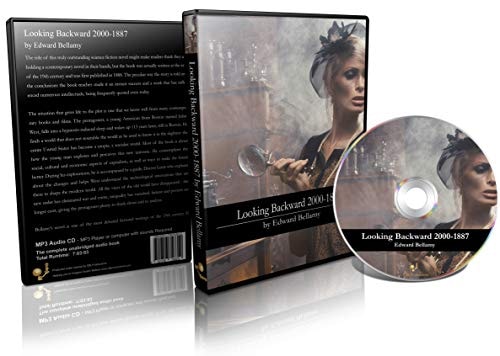
IDB Productions
2018
CreateSpace Independent Publishing Platform
2017
CreateSpace Independent Publishing Platform
2017
CreateSpace Independent Publishing Platform
2017
CreateSpace Independent Publishing Platform
2017
CreateSpace Independent Publishing Platform
2016
IDB Productions
2016

CreateSpace Independent Publishing Platform
2013
CreateSpace Independent Publishing Platform
2009
OUP Oxford
2009
Similar Books







Reader Comments
Share Your Thoughts
No comments yet. Be the first to share your thoughts!