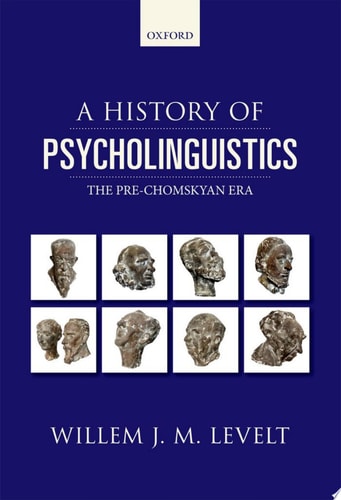
A History of Psycholinguistics: The Pre-Chomskyan Era
0
0
As an Amazon Associate and affiliate partner, Menrva Books earns from qualifying purchases. Learn more
Author Description
How do we manage to speak and understand language? How do children acquire these skills and how does the brain support them?These psycholinguistic issues have been studied for more than two centuries. Though many Psycholinguists tend to consider their history as beginning with the Chomskyan "cognitive revolution" of the late 1950s/1960s, the history of empirical psycholinguistics actually goes back to the end of the 18th century. This is the first book to comprehensively treat this "pre-Chomskyan" history. It tells the fascinating history of the doctors, pedagogues, linguists and psychologists who created this discipline, looking at how they made their important discoveries about the language regions in the brain, about the high-speed accessing of words in speaking and listening, on the child's invention of syntax, on the disruption of language in aphasic patients and so much more. The book is both a history of ideas as well of the men and women whose intelligence, brilliant insights, fads, fallacies, cooperations, and rivalries created this discipline. Psycholinguistics has four historical roots, which, by the end of the 19th century, had merged. By then, the discipline, usually called the psychology of language, was established. The first root was comparative linguistics, which raised the issue of the psychological origins of language. The second root was the study of language in the brain, with Franz Gall as the pioneer and the Broca and Wernicke discoveries as major landmarks. The third root was the diary approach to child development, which emerged from Rousseau's Émile. The fourth root was the experimental laboratory approach to speech and language processing, which originated from Franciscus Donders' mental chronometry. Wilhelm Wundt unified these four approaches in his monumental Die Sprache of 1900. These four perspectives of psycholinguistics continued into the 20th century but in quite divergent frameworks. There was German consciousness and thought psych
Menrva's Summary
THE THESIS
This book investigates the origins and development of psycholinguistics prior to the mid-20th-century cognitive revolution, challenging the notion that the field began with Noam Chomsky. Willem Levelt, a distinguished researcher in the field, utilizes historical archives and biographical data to trace the evolution of language study from the late 18th century through the early 20th century. He argues that the discipline emerged from the convergence of four distinct intellectual roots, ultimately unified by Wilhelm Wundt, and provides a rigorous framework for understanding the early scientific inquiry into speech, brain function, and language acquisition.
THE SCOPE MAP
What You Will Find
- Analysis of the four foundational roots: comparative linguistics, neurology, child development studies, and experimental mental chronometry.
- Biographical accounts of key figures including Franz Gall, Broca, Wernicke, and Wilhelm Wundt.
- Historical context regarding the study of aphasia and the psychological origins of language.
Scope Limits
- The text focuses exclusively on the pre-Chomskyan era and does not provide a detailed analysis of modern generative linguistics or contemporary cognitive neuroscience.
THE AUTHORITY PERSPECTIVE
Experts recognize this work as a definitive historical account that fills a significant gap in the literature of cognitive science. Readers frequently note the academic density of the prose, which serves as a foundational text for scholars and students interested in the intellectual history of language research.
Page Count:
671
Publication Date:
2012-01-01
Publisher:
OUP Oxford
ISBN-10:
0191627216
ISBN-13:
9780191627217
Psychology
Academic
Science History
Linguistics
Community Tags
Similar Books