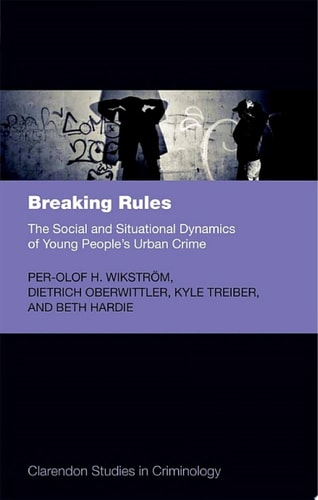
Breaking Rules: The Social and Situational Dynamics of Young People's Urban Crime
0
0
As an Amazon Associate and affiliate partner, Menrva Books earns from qualifying purchases. Learn more
Author Description
Why do certain people commit acts of crime? Why does crime happen in certain places? Presenting an ambitious new study designed to test a pioneering new theory of the causes of crime, Breaking Rules: The Social and Situational Dynamics of Young People's Urban Crime demonstrates that these questions can only go so far in explaining why crime happens - and, therefore, in preventing it. Based on the work of the Peterborough Adolescent and Young Adult Development Study (PADS+), Breaking Rules presents an analysis of the urban structure of Peterborough and its relation to young people's social life. Contemporary sciences state that behaviour is the outcome of an interaction between people and the environments to which they are exposed, and it is precisely that interaction and its relation to young people's crime involvement that PADS+ explores. Driven by a ground-breaking theory of crime, Situational Action Theory, which aims to explain why people break rules, it implements innovative methods of measuring social environments and people's exposure to them, involving a cohort of 700 young people growing up in the UK city of Peterborough. It focuses on the important adolescent time window, ages 12 to 17, during which young people's crime involvement is at its peak, using unique space-time budget data to explore young people's time use, movement patterns, and the spatio-temporal characteristics of their crime involvement. Presenting the first study of this kind, both in breadth and detail, with significant implications for policy and prevention, Breaking Rules should not only be of great interest to academic readers, but also to policy-makers and practitioners, interested in issues of urban environments, crime within urban environments, and the role of social environments in crime causation.
Menrva's Summary
THE THESIS
This study investigates the interaction between individual characteristics and environmental exposure to explain why young people engage in criminal behavior. The authors, a team of researchers associated with the Peterborough Adolescent and Young Adult Development Study (PADS+), utilize Situational Action Theory to move beyond traditional explanations of crime. By analyzing the spatio-temporal dynamics of adolescent life, the text argues that behavior is the direct result of the interplay between personal morality and the social settings individuals inhabit.
THE SCOPE MAP
What You Will Find
- Longitudinal data from a cohort of 700 young people in Peterborough, UK.
- Application of Situational Action Theory to urban crime patterns.
- Analysis of space-time budget data regarding adolescent movement and activity.
- Methodologies for measuring social environments and exposure levels.
Scope Limits
- The study is geographically restricted to the urban environment of Peterborough.
- The research focuses specifically on the adolescent window of ages 12 to 17.
THE AUTHORITY PERSPECTIVE
Experts recognize this work as a significant empirical application of Situational Action Theory within the field of criminology. Readers frequently note the academic density of the prose, which serves as a rigorous resource for researchers and policy-makers interested in environmental criminology.
Page Count:
512
Publication Date:
2012-01-01
Publisher:
OUP Oxford
ISBN-10:
0191634107
ISBN-13:
9780191634109
Psychology
Social Science
Urban Studies
Public Policy
Sociology
Criminology
Professional Career & Trade
Community Tags
Similar Books




Reader Comments
Share Your Thoughts
No comments yet. Be the first to share your thoughts!