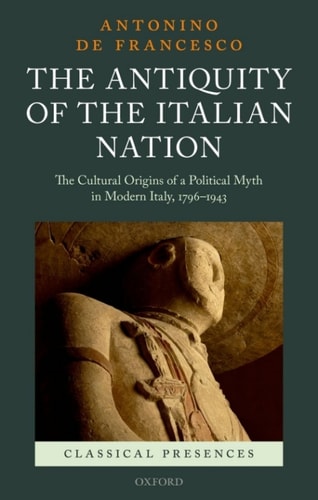
The Antiquity of the Italian Nation: The Cultural Origins of a Political Myth in Modern Italy, 1796-1943
0
0
As an Amazon Associate and affiliate partner, Menrva Books earns from qualifying purchases. Learn more
Author Description
With Italy under Napoleonic rule at the beginning of the nineteenth century, the antiquarian topic of anti-romanism became a pillar of the Italian nation-building process and, in turn, was used against the dominant French culture. The history of the Italian nation predating the Roman Empire supported the idea of an Italian cultural primacy and proved crucial in the creation of modern Italian nationalism. Towards the end of the nineteenth century, Italian studies of Roman history would drape a dark veil over the earliest history of Italy while Fascism openly claimed the legacy of the Roman Empire. Italic antiquity would, however, remain alive through all those years, intersecting with the political and cultural life of modern Italy. In this book, De Francesco examines the different uses of the constantly reasserted antiquity of the Italian nation in history, archaeology, palaeoethnology, and anthropology from the Napoleonic period to the collapse of Fascism.
Menrva's Summary
THE THESIS
This book investigates how the construction of an ancient, pre-Roman Italian identity served as a foundational myth for modern Italian nationalism between 1796 and 1943. Antonino De Francesco, a scholar of modern Italian history, utilizes a multidisciplinary approach to analyze how intellectuals, archaeologists, and politicians manipulated historical narratives to assert cultural primacy. By examining the shift from anti-Roman sentiment during the Napoleonic era to the Fascist appropriation of Roman imperial legacy, the author demonstrates how the concept of 'Italic antiquity' functioned as a persistent political tool throughout the nineteenth and early twentieth centuries.
THE SCOPE MAP
What You Will Find
- Analysis of the evolution of Italian national identity from the Napoleonic period through the collapse of Fascism.
- Examination of the intersection between political ideology and academic disciplines including archaeology, palaeoethnology, and anthropology.
- Case studies on the shifting interpretations of Roman versus pre-Roman history in Italian discourse.
Scope Limits
- The study does not focus on the actual archaeological findings themselves, but rather on the political and cultural interpretation of those findings.
- The analysis concludes with the fall of the Fascist regime and does not extend into post-war Italian historiography.
THE AUTHORITY PERSPECTIVE
Scholars in the field of European nationalism and historiography recognize this work as a rigorous examination of the intellectual origins of Italian political identity. Readers frequently note the academic density of the prose, which provides a detailed look at how historical myths are manufactured to serve state-building agendas.
Page Count:
288
Publication Date:
2013-01-01
Publisher:
OUP Oxford
ISBN-10:
0191639389
ISBN-13:
9780191639388
History
Nationalism
Historiography
Ancient History
European History
Italian History
Community Tags
Similar Books