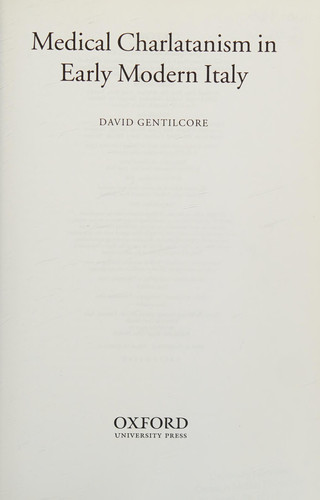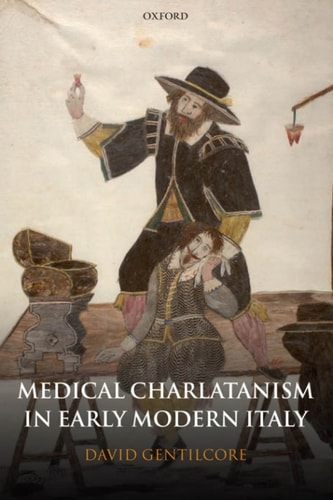
Medical Charlatanism in Early Modern Italy
0
0
As an Amazon Associate and affiliate partner, Menrva Books earns from qualifying purchases. Learn more
Author Description
From the mid-sixteenth century onwards, the Italian Protomedicato tribunals, Colleges of Physicians, or Health Offices (jurisdiction varied from state to state) required charlatans to submit their wares for inspection and, upon approval, pay a licence fee in order to set up a stage from which to perform and sell them. The licensing of charlatans became an administrative routine. As far as the medical magistracies were concerned, charlatans had a defineable identity, constituting a specific trade or occupation. This book studies the way charlatans were represented, by contemporaries and by historians, how they saw themselves and, most importantly, it reconstructs the place of charlatans in early modern Italy. It explores the goods and services charlatans provided, their dealings with the public and their marketing strategies. It does so from a range of perspectives: social, cultural, economic, political, geographical, biographical and, of course, medical. Charlatans are not just some curiosity on the fringes of medicine: they offered health care to an extraordinarily wide sector of the population. Moreover, from their origins in Renaissance Italy, the Italian ciarlatano was the prototype for itinerant medical practitioners throughout Europe. This book offers a different look at charlatans. It is the first to take seriously the licences issued to charlatans in the Italian states, compiling them into a 'charlatans database' of over 1,300 charlatans active throughout Italy over the course of some three centuries. In addition, it makes use of other types of archival documents, such as trial records and wills, to give the charlatans a human face, as well as a wide range of artistic and printed sources, not forgetting the output of the charlatans themselves, in the form of handbills and pamphlets.
Menrva's Summary
THE THESIS
This book investigates the role, regulation, and societal impact of itinerant medical practitioners, known as charlatans, within the administrative and cultural framework of early modern Italy. David Gentilcore, a historian specializing in the history of medicine, utilizes a vast collection of archival data—including over 1,300 individual licenses—to challenge the traditional view of charlatans as mere fringe figures. By analyzing trial records, wills, and contemporary printed materials, the author argues that these practitioners were integral to the healthcare landscape of the period and served as the prototype for itinerant medicine across Europe.
THE SCOPE MAP
What You Will Find
- A comprehensive database of over 1,300 licensed charlatans active in Italy over three centuries.
- Analysis of the administrative relationship between charlatans and the Protomedicato tribunals.
- Examination of marketing strategies, handbills, and pamphlets used by itinerant sellers.
- Multi-disciplinary perspectives including social, economic, political, and biographical lenses.
Scope Limits
- The study focuses primarily on the Italian states and does not provide an exhaustive history of itinerant medicine in Northern or Western Europe.
- The analysis is constrained by the survival of archival documentation and the specific regulatory practices of the Italian medical magistracies.
THE AUTHORITY PERSPECTIVE
Scholars and historians recognize this work as a foundational text for understanding the intersection of medical regulation and popular culture in the early modern period. Readers frequently note the meticulous archival research and the author's ability to synthesize complex administrative records into a coherent social history.
Page Count:
448
Publication Date:
2006-01-01
Publisher:
OUP Oxford
ISBN-10:
0191514292
ISBN-13:
9780191514296
History
Cultural History
Italian History
Early Modern
MEDICAL History
Medicine_italy
European History
Medicine history
Social History