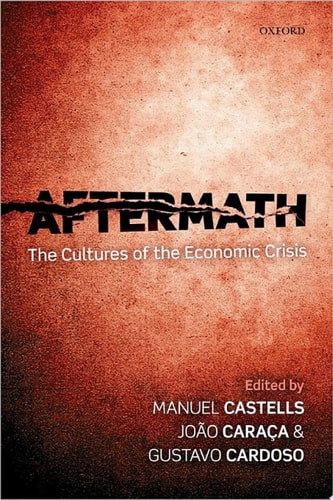
Aftermath: The Cultures of the Economic Crisis
0
0
As an Amazon Associate and affiliate partner, Menrva Books earns from qualifying purchases. Learn more
Author Description
The crisis of global capitalism that has unfolded since 2008 is more than an economic crisis. It is structural and multidimensional. The sequence of events that have taken place in its aftermath show that we are entering a world that is very different from the social and economic conditions that characterized the rise of global, informational capitalism in the preceding three decades. The policies and strategies that intended to manage the crisis-with mixed results depending on the country-may usher in a distinctly different economic and institutional system, as the New Deal, the construction of the European Welfare State, and the Bretton Woods global financial architecture all gave rise to a new form of capitalism in the aftermath of the 1930s Depression, and World War II. This volume examines the cultures and institutions at the root of the crisis, as well as the conflicts and debates that lead to a new social landscape, including the rise of alternative economic cultures expressed in the social movements occupying Wall Street. The book presents the results of a shared project of reflection by an interdisciplinary group of researchers from around the world. It contends that there is no quick fix to the current financial and political system. Life beyond the crisis requires a transformation of the mindset that led to bankruptcy and despair, and to economies and societies based on an unsustainable model of speculative finance and political irresponsibility. The book explains why and explores the contours of the world emerging in the aftermath of the crisis.
Menrva's Summary
THE THESIS
This work investigates whether the 2008 global economic crisis represents a fundamental, structural shift in the nature of capitalism rather than a temporary market fluctuation. The authors, a team of international interdisciplinary researchers led by Manuel Castells, utilize a comparative institutional analysis to argue that the crisis stems from deep-seated cultural and political failures. They contend that recovery requires a total transformation of the prevailing mindset of speculative finance and institutional irresponsibility, drawing parallels to the systemic changes that followed the Great Depression and World War II.
THE SCOPE MAP
What You Will Find
- Analysis of the cultural and institutional roots of the 2008 financial collapse
- Comparative studies of international policy responses to the crisis
- Examination of emerging social movements, such as Occupy Wall Street, as indicators of new economic cultures
- Theoretical framework for understanding the transition from informational capitalism to a new institutional system
Scope Limits
- Does not provide a technical manual for financial market recovery or specific investment strategies
- Does not offer a singular, predictive model for the exact future state of global capitalism
THE AUTHORITY PERSPECTIVE
Experts frequently cite this text as a significant contribution to the sociological understanding of global financial systems. Readers often note the academic density of the prose, which is tailored for scholars and students of political economy and social theory.
Page Count:
329
Publication Date:
2012-01-01
Publisher:
OUP Oxford
ISBN-10:
0191636959
ISBN-13:
9780191636950
Economics
Finance
Globalization
MIS
Economics history
Macroeconomic Theory
Information Management
Sociology
Community Tags
Similar Books