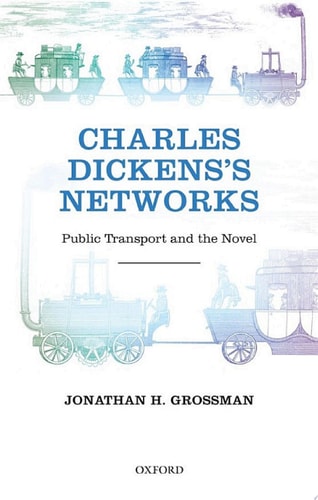
Charles Dickens's Networks: Public Transport and the Novel
0
0
As an Amazon Associate and affiliate partner, Menrva Books earns from qualifying purchases. Learn more
Author Description
The same week in February 1836 that Charles Dickens was hired to write his first novel, The Pickwick Papers, the first railway line in London opened. Charles Dickens's Networks explores the rise of the global, high-speed passenger transport network in the nineteenth century and the indelible impact it made on Dickens's work. The advent first of stage coaches, then of railways and transoceanic steam ships made unprecedented round-trip journeys across once seemingly far distances seem ordinary and systematic. Time itself was changed. The Victorians overran the separate, local times kept in each town, establishing instead the synchronized, 'standard' time, which now ticks on our clocks. Jonathan Grossman examines the history of public transport's systematic networking of people and how this revolutionized perceptions of time, space, and community, and how the art form of the novel played a special role in synthesizing and understanding it all. Focusing on a trio of road novels by Charles Dickens, he looks first at a key historical moment in the networked community's coming together, then at a subsequent recognition of its tragic limits, and, finally, at the construction of a revised view that expressed the precarious, limited omniscient perspective by which passengers came to imagine their journeying in the network.
Menrva's Summary
THE THESIS
This book investigates how the emergence of nineteenth-century public transport networks fundamentally reshaped the Victorian perception of time, space, and community, and how Charles Dickens utilized the novel form to synthesize these systemic changes. Jonathan H. Grossman, a scholar of Victorian literature, analyzes the parallel development of the railway and the Dickensian novel. He argues that the transition from local, fragmented time to synchronized, standard time was mirrored in the narrative structures of Dickens's road novels, which captured the new, precarious experience of modern travel.
THE SCOPE MAP
What You Will Find
- Historical analysis of the rise of stagecoaches, railways, and transoceanic steamships.
- Examination of the shift from local timekeeping to synchronized standard time.
- Literary analysis of three specific road novels by Charles Dickens.
- Theoretical framework regarding the 'limited omniscient' perspective of the passenger.
Scope Limits
- The study does not provide a comprehensive biography of Charles Dickens.
- The analysis is restricted to the specific impact of transport networks rather than a general survey of Victorian infrastructure.
THE AUTHORITY PERSPECTIVE
Scholars recognize this work as a significant contribution to the study of Victorian literature and its intersection with technological history. Readers frequently note the academic density of the prose, which provides a rigorous framework for understanding how infrastructure influences narrative form.
Page Count:
270
Publication Date:
2012-01-01
Publisher:
OUP Oxford
ISBN-10:
0191632325
ISBN-13:
9780191632327
History
Victorian
Transportation
Technology history
Transportation History
Literary Criticism
Community Tags
Similar Books