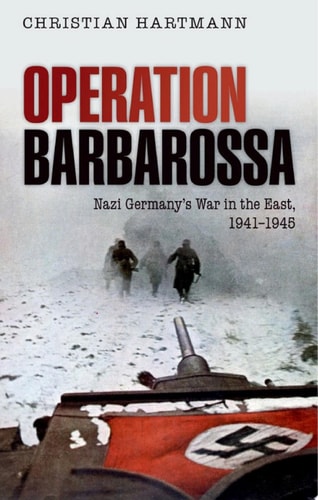
Operation Barbarossa: Nazi Germany's War in the East, 1941-1945
0
0
As an Amazon Associate and affiliate partner, Menrva Books earns from qualifying purchases. Learn more
Author Description
The war between Nazi Germany and Stalin's Soviet Union that raged between 1941 and 1945 was the ultimate confrontation between the two great totalitarian ideologies of the twentieth century. Unprecedented in the scale of the destruction that it wrought and the deep historical scars that it left behind, it was a gargantuan conflict in every sense of the term: in the vast territories over which it ranged, its intensity and duration, the huge numbers of people involved -- and last but by no means least, the millions of victims that it claimed. The invasion of the Soviet Union was the conflict that Hitler had always ultimately planned for: a pitiless war of conquest and destruction in which the Fuehrer dreamed of creating his 'Thousand Year Reich', destroying his ideological opponents, and enslaving or 'eliminating' whole peoples in the process. It was right from the start a struggle for survival, conducted with great bitterness and savagery by opponents who knew that defeat meant the destruction of everything they stood for. The outcome of this bitter struggle was quite as momentous as the struggle which had preceded it. By 1945 a huge swathe of Europe between Berlin and Moscow had been reduced to a devastated wasteland in which whole societies had been erased from the face of the earth. Over 26 million Soviets and between four and five million Germans lay dead. The victory of the Red Army transformed the Soviet Union into one of the world's two superpowers. It also saw the complete destruction of Hitler's megalomaniac vision for the East, the division of the German Reich, and the Soviet domination of Eastern Europe for a generation. In Operation Barbarossa, German military historian Christian Hartmann draws upon the latest research, enriched by a wealth of eye-witness testimony from both the Soviet and the German sides, to paint a masterly overview of these momentous four years and their human consequences - one that is both gripping, and at times deeply moving.
Menrva's Summary
THE THESIS
This work investigates the strategic, ideological, and human dimensions of the conflict between Nazi Germany and the Soviet Union from 1941 to 1945. Christian Hartmann, a German military historian, utilizes contemporary archival research and personal accounts to analyze the motivations behind Hitler's invasion and the subsequent total war that reshaped the geopolitical landscape of the twentieth century. The text argues that the conflict functioned as an existential struggle driven by competing totalitarian ideologies, resulting in unprecedented destruction and the eventual emergence of the Soviet Union as a global superpower.
THE SCOPE MAP
What You Will Find
- Analysis of the ideological foundations of the Eastern Front
- Examination of the scale of human casualties and societal destruction
- Integration of primary source eye-witness testimonies from both German and Soviet perspectives
- Overview of the military progression from the 1941 invasion to the 1945 collapse of the Third Reich
Scope Limits
- Does not provide a minute-by-minute tactical breakdown of every individual engagement
- Focuses primarily on the Eastern Front rather than the broader global theater of World War II
THE AUTHORITY PERSPECTIVE
Experts recognize this text as a comprehensive and balanced overview of the Eastern Front that effectively synthesizes complex military history with human-centric narratives. Readers frequently note that the prose remains accessible while maintaining the academic rigor expected of a professional historian.
Page Count:
190
Publication Date:
2013-01-01
Publisher:
OUP Oxford
ISBN-10:
0191636541
ISBN-13:
9780191636547
History
Military Strategy
European History
Military History
World War
Community Tags
Other Editions(2)

Similar Books
Reader Comments
Share Your Thoughts
No comments yet. Be the first to share your thoughts!