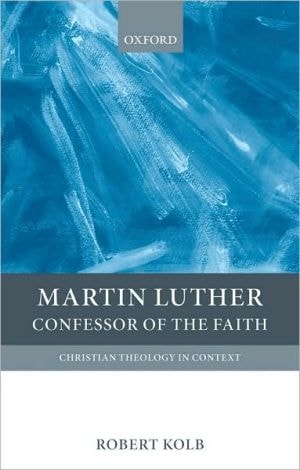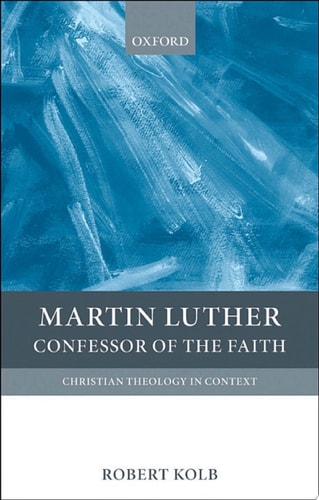
Martin Luther: Confessor of the Faith
0
0
As an Amazon Associate and affiliate partner, Menrva Books earns from qualifying purchases. Learn more
Author Description
Martin Luther's thought continues to challenge people throughout the world in the twenty-first century. His paradigmatic shift in defining God and what it means to be human left behind a foundation for viewing human creatures that was anchored in Aristotle's anthropology. Luther defined the Revealed God in terms of his mercy and love for human beings, based not on their merit and performance but rather on his unconditioned grace. He placed 'fearing, loving, and trusting God above all else' at the heart of his definition of being human. This volume places the development and exposition of these key presuppositions in Luther's thinking within the historical context of late medieval theology and piety as well as the unfolding dynamics of political and social change at the dawn of the modern era. Special attention is given the development of a 'Wittenberg way' of practicing theology under Luther's leadership. It left behind a dependence on allegorical methods of biblical interpretation for a 'literal-prophetic' approach to Scripture. More importantly, it placed the distinction between the 'gospel' as God's unmerited gift of identity as his children and the 'law', the expression of God's expectations for the performance of his children in good works, at the heart of all interpretation of the Bible. This presuppositional framework for practicing theology reflects Luther's personal experience and his deep commitment to pastoral care of common Christians as well as his reading of the biblical text. It is supported by his distinction of two kinds of human righteousness (passive in God's sight, active in relationship to others), his distinction of two realms or dimensions of human life, and his theology of the cross. The volume unfolds Luther's maturing thought on the basis of this method.
Menrva's Summary
THE THESIS
This volume investigates how Martin Luther’s theological framework redefined the relationship between God and humanity within the context of the late medieval era. Robert Kolb, a scholar of Reformation history, utilizes Luther’s personal writings and historical records to argue that Luther’s shift toward unconditioned grace and the distinction between law and gospel formed the core of his theological methodology. The author examines how these ideas emerged from Luther’s pastoral commitments and his departure from traditional allegorical biblical interpretation.
THE SCOPE MAP
What You Will Find
- Analysis of the 'Wittenberg way' of theological practice.
- Examination of the distinction between law and gospel in biblical interpretation.
- Discussion of the two kinds of human righteousness and the two realms of human life.
- Historical context regarding late medieval piety and social change.
Scope Limits
- The text does not provide a comprehensive biography of Luther’s entire life.
- It does not focus on the political history of the Holy Roman Empire outside of its impact on Luther’s theology.
THE AUTHORITY PERSPECTIVE
Scholars and students of Reformation history frequently cite this work as a rigorous examination of Luther’s theological presuppositions. Experts highlight the text for its clear articulation of complex theological distinctions and its focus on the pastoral motivations behind Luther’s academic output.
Page Count:
224
Publication Date:
2009-01-01
Publisher:
OUP Oxford
ISBN-10:
0191647470
ISBN-13:
9780191647475
History
Biography
Religion
Reformation
Christian Theology