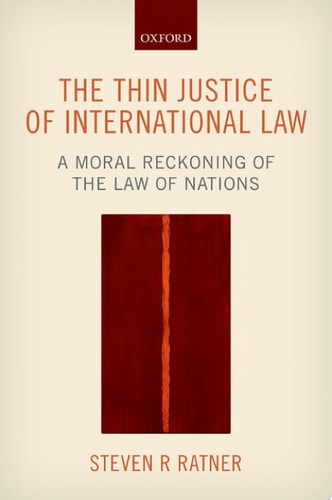
The Thin Justice of International Law
0
0
As an Amazon Associate and affiliate partner, Menrva Books earns from qualifying purchases. Learn more
Author Description
In A World Full Of Armed Conflict And Human Misery, Global Justice Remains One Of The Most Compelling Missions Of Our Time. Understanding The Promises And Limitations Of Global Justice Demands A Careful Appreciation Of International Law, The Web Of Binding Norms And Institutions That Help Govern The Behaviour Of States And Other Global Actors. This Book Provides A New Interdisciplinary Approach To Global Justice, One That Integrates The Work And Insights Of International Law And Contemporary Ethics. It Asks Whether The Core Norms Of International Law Are Just, Appraising Them According To A Standard Of Global Justice Derived From The Fundamental Values Of Peace And The Protection Of Human Rights. Through A Combination Of A Careful Explanation Of The Legal Norms And Philosophical Argument, Ratner Concludes That Many International Law Norms Meet Such A Standard Of Justice, Even As Distinct Areas Of Injustice Remain Within The Law And The Verdict Is Still Out On Others. Among The Subjects Covered In The Book Are The Rules On The Use Of Force, Self-determination, Sovereign Equality, The Decision Making Procedures Of Key International Organizations, The Territorial Scope Of Human Rights Obligations (including Humanitarian Intervention), And Key Areas Of International Economic Law. Ultimately, The Book Shows How An Understanding Of International Law's Moral Foundations Will Enrich The Global Justice Debate, While Exposing The Ethical Consequences Of Different Rules.
Menrva's Summary
THE THESIS
This book investigates whether the core norms of international law satisfy a standard of justice rooted in the fundamental values of peace and human rights protection. Steven R. Ratner, a scholar of international law, integrates legal analysis with contemporary ethical theory to evaluate the moral foundations of global governance. By applying a philosophical framework to existing legal structures, the author assesses the legitimacy of rules governing state behavior and international institutions.
THE SCOPE MAP
What You Will Find
- Analysis of rules regarding the use of force and sovereign equality
- Examination of self-determination and humanitarian intervention
- Evaluation of decision-making procedures in international organizations
- Discussion of international economic law and human rights obligations
Scope Limits
- The text does not provide an exhaustive history of every international treaty
- It does not offer a comprehensive guide to litigating international law cases
THE AUTHORITY PERSPECTIVE
Legal scholars and political theorists frequently cite this work for its rigorous interdisciplinary approach to evaluating international norms. Experts highlight the text as a significant contribution to the intersection of jurisprudence and moral philosophy for both students and practitioners.
Page Count:
500
Publication Date:
2015-01-01
Publisher:
Oup Oxford
ISBN-10:
0191009105
ISBN-13:
9780191009105
Human rights
International relations
Ethics
International Law
Political Philosophy
Law
Community Tags
Similar Books