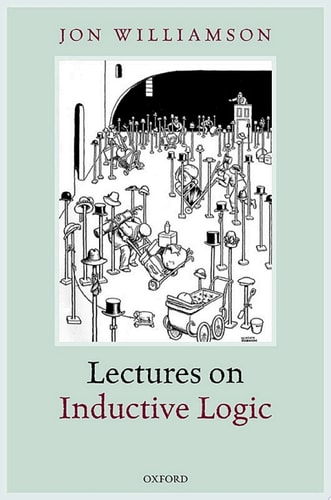
Lectures on Inductive Logic
0
0
As an Amazon Associate and affiliate partner, Menrva Books earns from qualifying purchases. Learn more
Author Description
Logic is a field studied mainly by researchers and students of philosophy, mathematics and computing. Inductive logic seeks to determine the extent to which the premisses of an argument entail its conclusion, aiming to provide a theory of how one should reason in the face of uncertainty. It has applications to decision making and artificial intelligence, as well as how scientists should reason when not in possession of the full facts. In this book, Jon Williamson embarks on a quest to find a general, reasonable, applicable inductive logic (GRAIL), all the while examining why pioneers such as Ludwig Wittgenstein and Rudolf Carnap did not entirely succeed in this task. Along the way he presents a general framework for the field, and reaches a new inductive logic, which builds upon recent developments in Bayesian epistemology (a theory about how strongly one should believe the various propositions that one can express). The book explores this logic in detail, discusses some key criticisms, and considers how it might be justified. Is this truly the GRAIL? Although the book presents new research, this material is well suited to being delivered as a series of lectures to students of philosophy, mathematics, or computing and doubles as an introduction to the field of inductive logic
Menrva's Summary
THE THESIS
This book investigates the possibility of constructing a General, Reasonable, Applicable Inductive Logic (GRAIL) to provide a framework for reasoning under conditions of uncertainty. Jon Williamson, a scholar in the field of philosophy and computing, evaluates the historical attempts of figures like Wittgenstein and Carnap to establish such a system. He proposes a new inductive logic rooted in Bayesian epistemology, arguing that this framework offers a robust method for decision-making and scientific inquiry when complete information is unavailable.
THE SCOPE MAP
What You Will Find
- A comprehensive framework for inductive logic based on Bayesian epistemology.
- Critical analysis of historical logical theories and their limitations.
- Theoretical applications for artificial intelligence and scientific reasoning.
Scope Limits
- The text does not provide an exhaustive history of all logical schools of thought.
- It does not serve as a general introduction to formal logic for those without a background in philosophy or mathematics.
THE AUTHORITY PERSPECTIVE
Experts recognize this work as a significant contribution to contemporary epistemology and formal logic. Readers frequently note the academic density of the prose, which is structured to function both as a research monograph and a lecture series for advanced students.
Page Count:
215
Publication Date:
2017-01-01
Publisher:
OUP Oxford
ISBN-10:
0191644552
ISBN-13:
9780191644559
Philosophy
Epistemology
Logic
Mathematics Statistics
Mathematics
Post-Calculus
Computer Science
Community Tags
Other Editions(3)


Similar Books