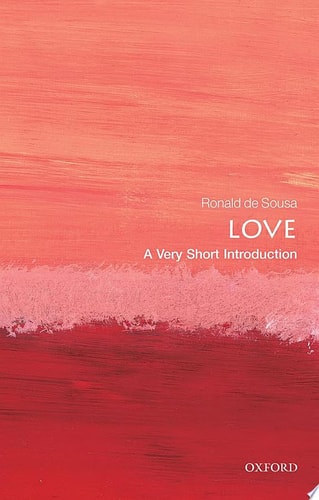
Love: A Very Short Introduction
0
0
As an Amazon Associate and affiliate partner, Menrva Books earns from qualifying purchases. Learn more
Author Description
Although there are many kinds of love, erotic love has been celebrated in art and poetry as life's most rewarding and exalting experience, worth living and dying for and bringing out the best in ourselves. And yet it has excused, and even been thought to justify, the most reprehensible crimes. Why should this be? This Very Short Introduction explores this and other puzzling questions. Do we love someone for their virtue, their beauty, or their moral or other qualities? Are love's characteristic desires altruistic or selfish? Are there duties of love? What do the sciences - neuroscience, evolutionary and social psychology, and anthropology - tell us about love? Many of the answers we give to such questions are determined not so much by the facts of human nature as by the ideology of love. Ronald de Sousa considers some of the many paradoxes raised by love, looking at the different kinds of love - affections, affiliation, philia, storage, agape, but focusses on eros, or romantic love. He considers whether our conventional beliefs about love and sex are deeply irrational and argues that alternative conceptions of love and sex, although hard to formulate and live by, may be worth striving for. ABOUT THE SERIES: The Very Short Introductions series from Oxford University Press contains hundreds of titles in almost every subject area. These pocket-sized books are the perfect way to get ahead in a new subject quickly. Our expert authors combine facts, analysis, perspective, new ideas, and enthusiasm to make interesting and challenging topics highly readable.
Menrva's Summary
THE THESIS
This book investigates the paradoxes of romantic love, questioning why an experience often associated with virtue and exaltation can simultaneously justify reprehensible behavior. Ronald de Sousa, a philosopher specializing in the philosophy of emotion, utilizes a multidisciplinary framework to examine the intersection of human nature and the cultural ideologies surrounding love. He challenges conventional beliefs by contrasting historical and philosophical perspectives with contemporary findings from neuroscience, evolutionary psychology, and anthropology.
THE SCOPE MAP
What You Will Find
- Philosophical analysis of various forms of love including philia, storge, and agape
- Examination of the tension between altruism and selfishness in romantic desire
- Integration of scientific data from neuroscience and social psychology
- Critique of the societal ideologies that shape modern romantic expectations
Scope Limits
- Does not provide a comprehensive history of romantic literature or art
- Does not offer practical advice or self-help strategies for personal relationships
THE AUTHORITY PERSPECTIVE
Readers frequently note the academic density of the prose, which provides a rigorous philosophical foundation for a complex subject. Experts highlight this as a concise yet challenging text that effectively synthesizes disparate scientific and philosophical viewpoints for the general reader.
Page Count:
152
Publication Date:
2015-01-01
Publisher:
OUP Oxford
ISBN-10:
0191640522
ISBN-13:
9780191640520
Philosophy
Psychology
Politics
Non-Fiction
Kindle Store
Movements
Sociology
Academic
Counseling Psychology
Categories
Kindle eBooks