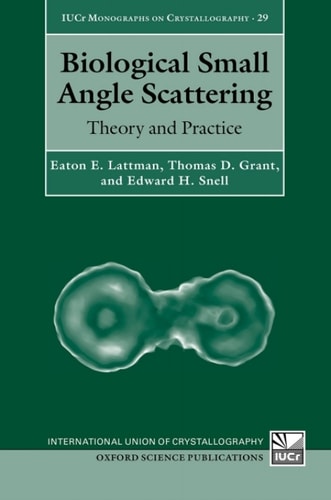
Biological Small Angle Scattering: Theory and Practice
0
0
As an Amazon Associate and affiliate partner, Menrva Books earns from qualifying purchases. Learn more
Author Description
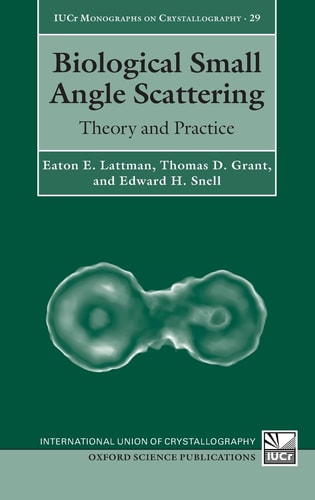
Small angle solution scattering (SAS) is increasingly being applied to biological problems. It is a complementary technique that, when applied in appropriate circumstances with carefully structured questions, can provide unique information not available from other techniques. While small angle solution scattering has been around for some time, a confluence of recent developments has dramatically enhanced its power. Intense third generation X-ray sources, low noise detectors, development of new algorithms and the computational power to take advantage of these have all matured, and use of free-electron x-ray laser sources is on the horizon. Whole new classes of experiments and analyses have been created as a result. These include the generation of molecular envelopes, the ability to do time-resolved studies, and the ability to account for structural changes using modelling based on the SAS data. The technical improvements have also reduced the amount of time and material needed to carry out an experiment. Beamtime at synchrotron sources is in demand, workshops on the subject are popular and researchers adopting the technique as part of their repertoire are growing. With these in mind, this book was written to guide structural biologists who may wish to adopt the technique, understand its strengths and weaknesses or just have a general interest in its potential.
Menrva's Summary
THE THESIS
This book investigates the theoretical foundations and practical applications of small angle solution scattering (SAS) as a critical tool for modern structural biology. The authors, Eaton E. Lattman, Edward H. Snell, and Thomas D. Grant, leverage their expertise in crystallography to explain how recent advancements in X-ray sources, detector technology, and computational algorithms have expanded the utility of SAS. They provide a structured framework for researchers to evaluate when SAS is the appropriate methodology for addressing specific biological questions.
THE SCOPE MAP
What You Will Find
- Theoretical principles of small angle solution scattering
- Methodologies for generating molecular envelopes
- Techniques for conducting time-resolved structural studies
- Computational approaches for structural modeling based on scattering data
- Guidance on experimental design and resource optimization
Scope Limits
- Does not provide an exhaustive history of X-ray physics
- Does not cover advanced quantum mechanical derivations beyond the scope of practical application
THE AUTHORITY PERSPECTIVE
Experts recognize this volume as a practical resource for structural biologists seeking to integrate SAS into their research repertoire. Readers frequently note the clarity with which the authors bridge the gap between complex physical theory and laboratory application.
Page Count:
288
Publication Date:
2018-01-01
Publisher:
OUP Oxford
ISBN-10:
0191649899
ISBN-13:
9780191649899
Science
Physics
Biophysics
Biology