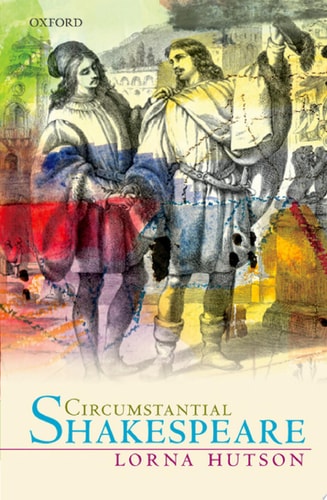
Circumstantial Shakespeare: Oxford Wells Shakespeare Lectures
0
0
As an Amazon Associate and affiliate partner, Menrva Books earns from qualifying purchases. Learn more
Author Description
Shakespeare's characters are thought to be his greatest achievement--imaginatively autonomous, possessed of depth and individuality, while his plots are said to be second-hand and careless of details of time and place. This view has survived the assaults of various literary theories and has even, surprisingly, been revitalized by the recent emphasis on the collaborative nature of early modern theatre. But belief in the autonomous imaginative life of Shakespeare's characters depends on another unexamined myth: the myth that Shakespeare rejected neoclassicism, playing freely with theatrical time and place. Circumstantial Shakespeare explodes these venerable critical commonplaces. Drawing on sixteenth-century rhetorical pedagogy, it reveals the importance of topics of circumstance (of Time, Place, and Motive, etc.) in the conjuring of compelling narratives and vivid mental images. 'Circumstances' -- which we now think of as incalculable contingencies -- were originally topics of forensic inquiry into human intention or passion. In drawing on the Roman forensic tradition of circumstantial proof, Shakespeare did not ignore time and place. His brilliant innovation was to use the topics of circumstance to imply offstage actions, times and places in terms of the motives and desires we attribute to the characters. His plays thus create both their own vivid and coherent dramatic worlds and a sense of the unconscious feelings of characters inhabiting them. Circumstantial Shakespeare offers new readings of Romeo and Juliet, King Lear, Lucrece, Two Gentlemen of Verona and Macbeth, as well as new interpretations of Sackville and Norton's Gorboduc and Beaumont and Fletcher's The Maid's Tragedy. It engages with eighteenth-century Shakespeare criticism, contemporary Shakespeare criticism, semiotics of theatre, Roman forensic rhetoric, humanist pedagogy, the prehistory of modern probability, psychoanalytic criticism and sixteenth-century constitutional thought.
Menrva's Summary
THE THESIS
This work investigates how Shakespeare utilized sixteenth-century forensic rhetoric and the 'topics of circumstance' to construct dramatic narrative and character interiority. Lorna Hutson, a prominent scholar in early modern literature, challenges the long-standing critical assumption that Shakespeare ignored neoclassical constraints of time and place. By grounding her analysis in humanist pedagogy and Roman forensic traditions, she argues that Shakespeare's innovation lay in using circumstantial proof to imply offstage actions and character motives, thereby creating the illusion of psychological depth.
THE SCOPE MAP
What You Will Find
- Analysis of sixteenth-century rhetorical pedagogy and forensic inquiry.
- Re-evaluations of Shakespearean texts including Romeo and Juliet, King Lear, and Macbeth.
- Examination of the intersection between probability, semiotics, and early modern constitutional thought.
Scope Limits
- The text does not provide a comprehensive biography of Shakespeare.
- It does not focus on performance history or modern stage adaptations.
THE AUTHORITY PERSPECTIVE
Scholars recognize this text as a significant intervention in Shakespearean studies that shifts the focus from character autonomy to the mechanics of rhetorical construction. Readers frequently note the academic density of the prose, which requires a foundational understanding of early modern rhetorical theory to fully grasp the author's arguments.
Page Count:
256
Publication Date:
2015-01-01
Publisher:
OUP Oxford
ISBN-10:
0191650854
ISBN-13:
9780191650857
English
Literary Criticism
History - Modern
English & College Success
Rhetoric
Drama Theory
Community Tags
Similar Books