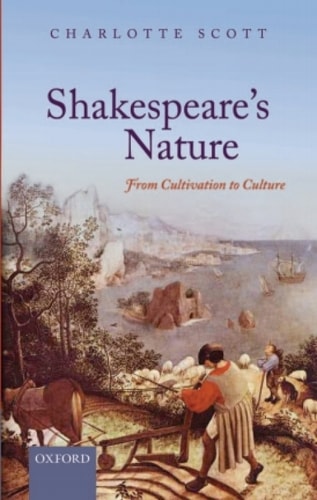
Shakespeare's Nature: From Cultivation to Culture
0
0
As an Amazon Associate and affiliate partner, Menrva Books earns from qualifying purchases. Learn more
Author Description
Shakespeare's Nature offers the first sustained account of the impact of the language and practice of husbandry on Shakespeare's work. It shows how the early modern discourse of cultivation changes attitude to the natural world, and traces the interrelationships between the human and the natural worlds in Shakespeare's work through dramatic and poetic models of intervention, management, prudence and profit. Ranging from the Sonnets to The Tempest, the book explains how cultivation of the land responds to and reinforces social welfare, and reveals the extent to which the dominant industry of Shakespeare's time shaped a new language of social relations. Beginning with an examination of the rise in the production of early modern printed husbandry manuals, Shakespeare's Nature draws on the varied fields of economic, agrarian, humanist, Christian and literary studies, showing how the language of husbandry redefined Elizabethan attitudes to both the human and non-human worlds. In a series of close readings of specific plays and poems, this book explains how cultivation forms and develops social and economic value systems, and how the early modern imagination was dependent on metaphors of investment, nurture and growth. By tracing this language of intervention and creation in Shakespeare's work, this book reveals a fundamental discourse in the development of early modern social, political and personal values.
Menrva's Summary
THE THESIS
This book investigates how the language and practices of early modern husbandry fundamentally shaped the social, economic, and political values embedded within Shakespeare's dramatic and poetic works. Charlotte C. Scott, a scholar of early modern literature, utilizes a multidisciplinary framework to analyze how the period's focus on land management and cultivation influenced the conceptualization of human and non-human relationships. By examining the intersection of economic history and literary production, the author argues that the discourse of husbandry provided a critical metaphor for investment, nurture, and social order in the Elizabethan imagination.
THE SCOPE MAP
What You Will Find
- Analysis of early modern printed husbandry manuals and their influence on literary language
- Close readings of selected works including the Sonnets and The Tempest
- Integration of economic, agrarian, humanist, and Christian historical contexts
Scope Limits
- The study focuses primarily on the influence of husbandry discourse rather than a comprehensive environmental history of the period
- The analysis is limited to Shakespearean texts and does not extend to the broader canon of contemporary playwrights
THE AUTHORITY PERSPECTIVE
Scholars frequently cite this work as a significant contribution to the intersection of economic history and literary analysis in the early modern period. Experts highlight the text for its rigorous methodology in connecting material agricultural practices to the development of abstract social and political metaphors.
Page Count:
272
Publication Date:
2014-01-01
Publisher:
OUP Oxford
ISBN-10:
0191508160
ISBN-13:
9780191508165
English & College Success
Literary Criticism
English
History - Modern
Cultural History
Community Tags
Similar Books