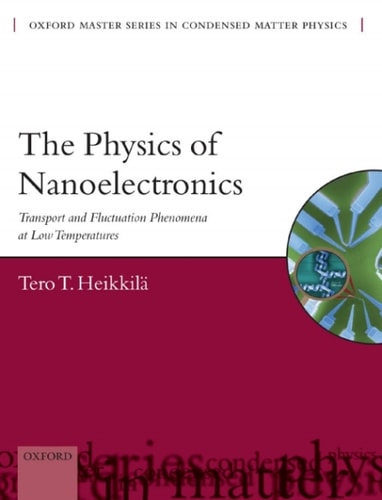
The Physics of Nanoelectronics: Transport and Fluctuation Phenomena at Low Temperatures
0
0
As an Amazon Associate and affiliate partner, Menrva Books earns from qualifying purchases. Learn more
Author Description
Advances in nanotechnology have allowed physicists and engineers to miniaturize electronic structures to the limit where finite-size related phenomena start to impact their properties. This book discusses such phenomena and models made for their description. The book starts from the semiclassical description of nonequilibrium effects, details the scattering theory used for quantum transport calculations, and explains the main interference effects. It also describes how to treat fluctuations and correlations, how interactions affect transport through small islands, and how superconductivity modifies these effects. The last two chapters describe new emerging fields related with graphene and nanoelectromechanics. The focus of the book is on the phenomena rather than formalism, but the book still explains in detail the main models constructed for these phenomena. It also introduces a number of electronic devices, including the single-electron transistor, the superconducting tunnel junction refrigerator, and the superconducting quantum bit.
Menrva's Summary
THE THESIS
This text investigates the physical phenomena and theoretical models governing electronic transport and fluctuations in miniaturized structures at low temperatures. Author Tero T. Heikkilä, a researcher in condensed matter physics, provides a systematic framework for understanding how finite-size effects impact electronic properties. The book synthesizes semiclassical descriptions, scattering theory, and quantum transport calculations to explain the behavior of devices operating at the nanoscale.
THE SCOPE MAP
What You Will Find
- Semiclassical descriptions of nonequilibrium effects
- Scattering theory for quantum transport calculations
- Analysis of interference effects, fluctuations, and correlations
- Models for transport through small islands and superconducting modifications
- Overviews of graphene and nanoelectromechanics
Scope Limits
- The text focuses on physical phenomena rather than exhaustive mathematical formalism
- It does not provide an exhaustive history of the field, focusing instead on contemporary models
THE AUTHORITY PERSPECTIVE
Experts identify this work as a structured resource for graduate-level students and researchers entering the field of nanoelectronics. Readers frequently note the balance between conceptual clarity and the technical rigor required to model complex quantum transport phenomena.
Page Count:
312
Publication Date:
2013-01-01
Publisher:
OUP Oxford
ISBN-10:
0191654469
ISBN-13:
9780191654466
Electronics
Engineering
Nanotechnology
Earth Sciences
Condensed Matter Physics
Physics