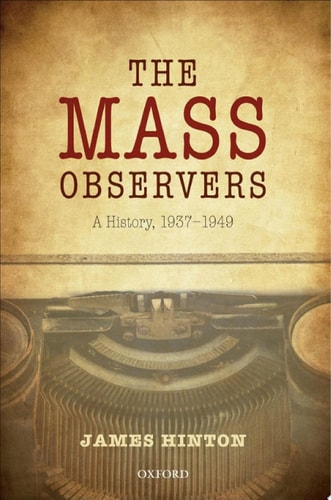
The Mass Observers: A History, 1937-1949
0
0
As an Amazon Associate and affiliate partner, Menrva Books earns from qualifying purchases. Learn more
Author Description
This is the first full-scale history of Mass-Observation, the independent social research organisation which, between 1937 and 1949, set out to document the attitudes, opinions, and every-day lives of the British people. Through a combination of anthropological fieldwork, opinion surveys, and written testimony solicited from hundreds of volunteers, Mass-Observation created a huge archive of popular life during a tumultuous decade which remains central to British national identity. The social history of these years has been immeasurably enriched by the archive, and extracts from the writings of M-O's volunteers have won a wide and admiring audience. Now James Hinton, whose acclaimed Nine Wartime Lives demonstrated how the intensely personal writing of some of M-O's volunteers could be used to shed light on broader historical issues, has written a wonderfully vivid and evocative account which does justice not only to the two founders whose tempestuous relationship dominated the early years of Mass-Observation, but also to the dozens of creative and imaginative, and until now largely unknown, young enthusiasts whose work helped to keep the show on the road. The history of the organisation itself - the staff, the research methods, the struggle for funding, M-O's characteristic 'voice', and its role in the cultural and political life of the period - are themselves as interesting as any of the themes that the founders set out to document. This long-awaited and deeply researched history corrects and revises much of our existing knowledge of Mass-Observation, opens up new and important perspectives on the organisation, and will be seen as the authoritative account for years to come.
Menrva's Summary
THE THESIS
This work investigates the origins, operational methodologies, and institutional evolution of the Mass-Observation organization during its most active period from 1937 to 1949. James Hinton, a historian specializing in the social history of mid-twentieth-century Britain, utilizes the extensive Mass-Observation archive to reconstruct the internal dynamics of the group. He examines how the organization's founders and volunteer network navigated the challenges of funding and methodology to document the lived experiences of the British public during a transformative era.
THE SCOPE MAP
What You Will Find
- A detailed institutional history of Mass-Observation from 1937 to 1949
- Analysis of the organization's research techniques, including anthropological fieldwork and volunteer-led surveys
- Examination of the interpersonal dynamics between the organization's founders
- Evaluation of the role of volunteer contributors in shaping the archive
Scope Limits
- The study focuses primarily on the period ending in 1949 and does not cover the later decades of the organization's existence
- The text prioritizes the internal history of the group over a comprehensive sociological analysis of the data collected
THE AUTHORITY PERSPECTIVE
Experts recognize this work as the definitive historical account of the Mass-Observation movement, noting its success in balancing institutional history with the personal narratives of the volunteers. Scholars frequently cite the text for its rigorous use of archival material and its ability to clarify the complex administrative history of the organization.
Page Count:
419
Publication Date:
2013-01-01
Publisher:
OUP Oxford
ISBN-10:
0191650625
ISBN-13:
9780191650628
History
Sociology
Public opinion
Great Britain
Social Science
British History
Mass Observation
European History
Community Tags
Similar Books