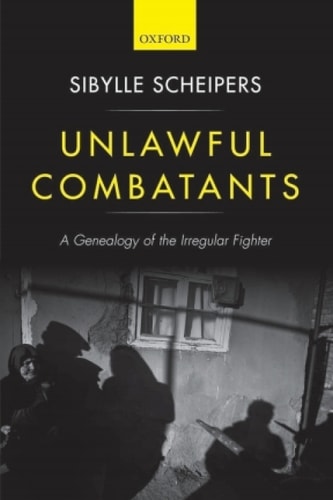
Unlawful Combatants: A Genealogy of the Irregular Fighter
0
0
As an Amazon Associate and affiliate partner, Menrva Books earns from qualifying purchases. Learn more
Author Description
Unlawful Combatants brings the study of irregular warfare back into the centre of war studies. The experience of recent and current wars in Afghanistan, Iraq, Libya, and Syria showed that the status and the treatment of irregular fighters is one of the most central and intricate practical problems of contemporary warfare. Yet, the current literature in strategic studies and international relations more broadly does not problematize the dichotomy between the regular and the irregular. Rather, it tends to take it for granted and even reproduces it by depicting irregular warfare as a deviation from the norm of conventional, inter-state warfare. In this context, irregular warfare is often referred to as the 'new wars' and is associated with the erosion of statehood and sovereignty more generally. This obscures the fact that irregulars such as rebels, guerrillas, insurgents and terrorist groups have a far more ambiguous relationship to the state than the dichotomy between the state and 'non-state' actors implies. They often originate from states, are supported by states and/or aspire to statehood themselves. The ambiguous relationship between irregular fighters and the state is the focus of the book. It explores how the category of the irregular fighter evolved as the conceptual opposite of the regular armed forces, and how this emergence was tied to the evolution of the nation state and its conscripted mass armies at the end of the eighteenth century. It traces the development of the dichotomy of the irregular and the regular, which found its foremost expression in the modern law of armed conflict, into the twenty-first century and provides a critique of the concept of the 'unlawful combatant' as it emerged in the framework of the 'war on terror'. This book is a project of Changing Character of War programme at the University of Oxford.
Menrva's Summary
THE THESIS
This book investigates the historical and conceptual origins of the 'unlawful combatant' category to challenge the binary distinction between regular and irregular warfare. Sibylle Scheipers, affiliated with the Changing Character of War programme at the University of Oxford, utilizes a genealogical approach to examine how the nation-state and its conscripted armies necessitated the creation of the 'irregular' as a conceptual opposite. The work argues that the relationship between non-state actors and the state is far more complex than current strategic literature acknowledges, as many irregular groups maintain deep, often state-sponsored, ties to the very sovereignty they are frequently depicted as eroding.
THE SCOPE MAP
What You Will Find
- A historical analysis of the evolution of the irregular fighter from the late eighteenth century to the present.
- A critical examination of the 'unlawful combatant' framework utilized during the 'war on terror'.
- An exploration of the interplay between the development of the nation-state and the codification of the law of armed conflict.
Scope Limits
- The text does not provide a comprehensive tactical manual for counter-insurgency operations.
- It does not offer a predictive model for the future of state-based warfare.
THE AUTHORITY PERSPECTIVE
Experts recognize this work as a significant contribution to the field of war studies for its rigorous deconstruction of long-standing military dichotomies. Readers frequently note the academic density of the prose, which is well-suited for scholars and practitioners of international law and security studies.
Page Count:
288
Publication Date:
2015-01-01
Publisher:
OUP Oxford
ISBN-10:
0191663654
ISBN-13:
9780191663659
Military History
International relations
War Studies
International Law
Community Tags
Similar Books