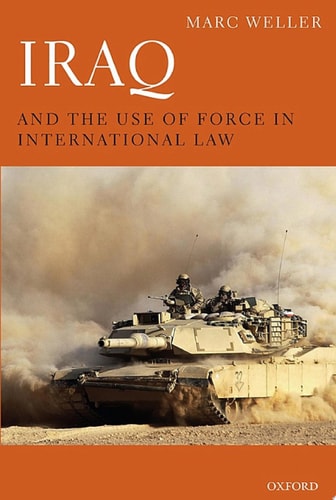
Iraq and the Use of Force in International Law
0
0
As an Amazon Associate and affiliate partner, Menrva Books earns from qualifying purchases. Learn more
Author Description
The prohibition of the use of force is one of the most crucial elements of the international legal order. Our understanding of that rule was both advanced and challenged during the period commencing with the termination of the Iran-Iraq war and the invasion of Kuwait, and concluding with the invasion and occupation of Iraq. The initial phase was characterized by hopes for a functioning collective security system administered by the United Nations as part of a New World Order. The liberation of Kuwait, in particular, was seen by some as a powerful vindication of the prohibition of the use of force and of the UN Security Council. However, the operation was not really conducted in accordance with the requirements for collective security established in the UN Charter. In a second phase, an international coalition launched a humanitarian intervention operation, first in the north of Iraq, and subsequently in the south. That episode is often seen as the fountainhead of the post-Cold War claim to a new legal justification for the use of force in circumstances of grave humanitarian emergency-a claim subsequent challenged during the armed action concerning Kosovo. There then followed repeated uses of force against Iraq in the context of the international campaign to remove its present or future weapons of mass destruction potential. Finally, the episode reached its controversial zenith with the full scale invasion of Iraq led by the US and the UK in 2003. This book analyzes these developments, and their impact on the rule prohibiting force in international relations, in a comprehensive and accessible way. It is the first to draw upon classified materials released by the UK Chilcot inquiry shedding light on the decision to go to war in 2003 and the role played by international law in that context.
Menrva's Summary
THE THESIS
This book investigates how the repeated use of force against Iraq from the late 1980s through the 2003 invasion fundamentally challenged and reshaped the international legal prohibition against the use of force. Marc Weller, an expert in international law, utilizes a rigorous legal framework to examine the evolution of collective security and humanitarian intervention. By synthesizing historical events with legal doctrine, the author evaluates whether these military actions adhered to the UN Charter or established new, controversial precedents for international conflict. The analysis provides a critical assessment of how state actors navigated legal justifications during a period of significant geopolitical transition.
THE SCOPE MAP
What You Will Find
- Analysis of the transition from the Iran-Iraq War through the 2003 invasion of Iraq.
- Examination of the UN Security Council's role in collective security operations.
- Legal evaluation of humanitarian intervention claims and weapons of mass destruction enforcement.
- Integration of previously classified materials from the UK Chilcot inquiry.
Scope Limits
- The text focuses primarily on the legal implications of the Iraq conflict rather than a comprehensive military history of the region.
- It does not provide an exhaustive analysis of domestic political factors within the involved nations outside of their legal decision-making processes.
THE AUTHORITY PERSPECTIVE
Legal scholars and practitioners frequently cite this work for its detailed integration of primary source documents and its clear articulation of complex international legal norms. Experts highlight the book as a significant resource for understanding the intersection of state practice and the evolution of the UN Charter in the post-Cold War era.
Page Count:
293
Publication Date:
2010-01-01
Publisher:
OUP Oxford
ISBN-10:
0191018422
ISBN-13:
9780191018428
History
Military History
International Law
International relations
Professional Career & Trade
Middle East
Community Tags
Other Editions(4)

Similar Books



Reader Comments
Share Your Thoughts
No comments yet. Be the first to share your thoughts!