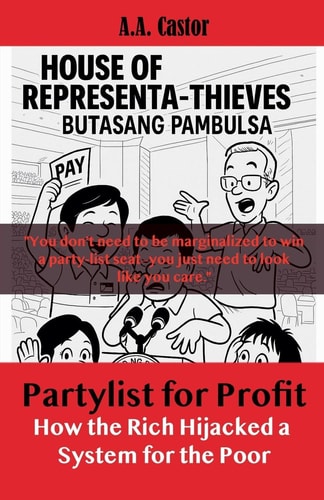
Partylist for Profit: How the Rich Hijacked a System for the Poor
0
0
As an Amazon Associate and affiliate partner, Menrva Books earns from qualifying purchases. Learn more
Author Description
Once designed to amplify the voices of farmers, laborers, and the underrepresented, the Philippine party-list system has now become the ultimate low-risk, high-reward investment for the well-connected. In Partylist for Profit: How the Rich Hijacked a System for the Poor, A.A. Castor peels back the glossy surface of legislative charity to expose the machinery of legalized profiteering, dynastic expansion, and quiet political laundering. With deadpan seriousness and a dose of dark humor, this book walks readers through the insider's playbook of how to build, fund, and quietly control a party-list with as little accountability-and as much profit-as possible. From choosing a vague advocacy ("OFWs" or "transport workers," anyone?) to securing alphabet-friendly names for ballot advantage, to recycling nominees across election cycles and repackaging greed as governance, this is not a how-to-this is a how-it's-done. Perfect for political junkies, aspiring operators, or just disillusioned citizens looking to finally understand why nothing ever changes, Partylist for Profit isn't just a book-it's a public service announcement disguised as satire. Learn how power is bought, maintained, and quietly passed down-not through revolution, but registration. After all, in today's politics, you don't need a platform. You just need a seat.
Menrva's Summary
THE THESIS
The Philippine party-list system, originally intended to empower marginalized sectors, has been co-opted by the wealthy and well-connected for personal and political gain. A.A. Castor's work meticulously details how this system, designed for representation, has transformed into a lucrative enterprise. The book exposes the mechanisms through which individuals and families leverage party-list organizations for financial profit, political influence, and the perpetuation of dynastic power. It analyzes the strategies employed, from selecting broad, appealing advocacy groups to manipulating electoral processes and recycling candidates, all while maintaining a facade of legitimate governance.
THE SCOPE MAP
- Analysis of the historical intent and evolution of the Philippine party-list system.
- Exposes the methods used by the wealthy to exploit the system for profit and power.
- Details strategies for establishing and controlling party-list organizations with minimal accountability.
- Examines the manipulation of advocacy group selection and ballot naming conventions.
- Discusses the practice of recycling nominees across election cycles.
- Critiques the repackaging of personal gain as effective governance.
- Targets readers interested in political strategy, corruption, and the mechanics of power.
THE AUTHORITY PERSPECTIVE
The book is presented as an exposé of systemic corruption within the Philippine party-list system, offering a critical look at how a mechanism for the underrepresented has been hijacked for profit. The description suggests a tone that is both serious and darkly humorous, aiming to educate readers on the inner workings of political maneuvering and legalized profiteering. It is positioned as essential reading for those seeking to understand the persistent issues in Philippine politics and the methods by which power is maintained and transferred through registration rather than policy.
Page Count:
294
Publication Date:
2025-04-08
Publisher:
A.A. Castor
ISBN-13:
9798224896530
Non-Fiction
Politics
Socioeconomics
Government
Corruption
Community Tags
Similar Books