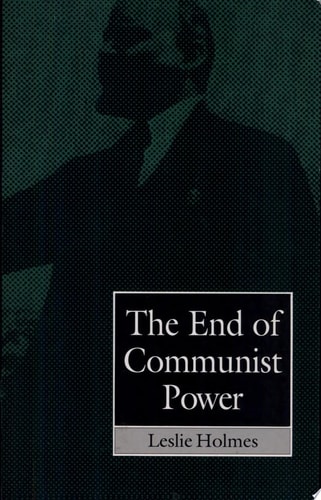
The End of Communist Power: Anti-Corruption Campaigns and Legitimation Crisis
0
0
As an Amazon Associate and affiliate partner, Menrva Books earns from qualifying purchases. Learn more
Author Description
Product Description Using an analytical, comparative approach that examines communist regimes from Moscow and Beijing to Havana and Kampuchea, Leslie Holmes argues that the extraordinarily rapid decline and collapse of communism in the USSR and Eastern Europe between 1989 and 1992 had its roots in the anti-corruption campaigns introduced in the early 1980s. Originally created to combat the disastrous economic reforms of the 1960s and '70s, the anti-corruption campaigns could not meet citizen expectations, and ultimately had the unintended effect of provoking a legitimation crisis throughout the communist world. Holmes studies this crisis in detail, investigating campaigns against official corruption in more than twenty communist states, with particular emphasis on the former USSR and the People's Republic of China. In a final chapter, Holmes locates the failure of communist power in the larger debate about the crisis of modernity, and argues--controversially--that the collapse of communism is not necessarily of much relevance to this alleged crisis. About the Author Leslie Holmes is at University of Melbourne.
Menrva's Summary
THE THESIS
This book investigates whether the anti-corruption campaigns initiated by communist regimes in the 1980s served as the primary catalyst for the subsequent legitimation crisis and collapse of communist power. Leslie Holmes, a scholar at the University of Melbourne, utilizes a comparative analytical framework to examine the internal political dynamics of over twenty communist states. By tracing the failure of these campaigns to meet public expectations, the author argues that the state's attempt to fix economic stagnation inadvertently exposed systemic weaknesses that undermined the party's authority. The work concludes by situating these political shifts within the broader academic discourse regarding the crisis of modernity.
THE SCOPE MAP
What You Will Find
- Comparative analysis of communist regimes across the USSR, Eastern Europe, China, Cuba, and Kampuchea.
- Examination of the causal link between 1980s anti-corruption initiatives and the 1989-1992 collapse.
- Evaluation of the legitimation crisis as a consequence of failed economic and political reform.
- Theoretical discussion on the relationship between communist collapse and the broader crisis of modernity.
THE AUTHORITY PERSPECTIVE
Scholars and political analysts frequently cite this work as a rigorous comparative study of the structural vulnerabilities inherent in late-stage communist governance. Experts highlight the author's controversial conclusion regarding the relevance of communist collapse to the wider crisis of modernity as a significant point of academic debate.
Page Count:
384
Publication Date:
1993-01-01
Publisher:
Oxford University Press
ISBN-10:
0195210131
ISBN-13:
9780195210132
History
International relations
Corruption
Communism
Government
Community Tags
Similar Books