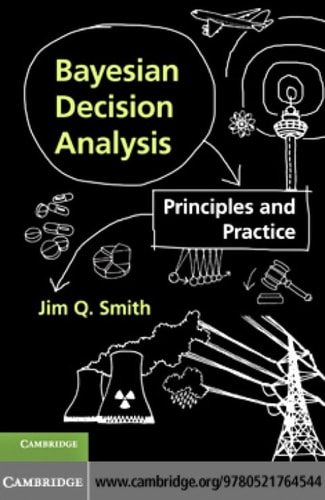
Bayesian Decision Analysis
0
0
As an Amazon Associate and affiliate partner, Menrva Books earns from qualifying purchases. Learn more
Author Description
Bayesian decision analysis supports principled decision making in complex domains. This textbook takes the reader from a formal analysis of simple decision problems to a careful analysis of the sometimes very complex and data rich structures confronted by practitioners. The book contains basic material on subjective probability theory and multi-attribute utility theory, event and decision trees, Bayesian networks, influence diagrams and causal Bayesian networks. The author demonstrates when and how the theory can be successfully applied to a given decision problem, how data can be sampled and expert judgements elicited to support this analysis, and when and how an effective Bayesian decision analysis can be implemented. Evolving from a third-year undergraduate course taught by the author over many years, all of the material in this book will be accessible to a student who has completed introductory courses in probability and mathematical statistics.
Menrva's Summary
THE THESIS
This textbook guides readers from basic decision problems to complex, data-rich scenarios using Bayesian decision analysis. The author, Jim Q. Smith, draws on years of teaching experience to present material accessible to students with introductory probability and statistics coursework. It covers subjective probability theory, multi-attribute utility theory, event and decision trees, Bayesian networks, influence diagrams, and causal Bayesian networks. The book emphasizes practical application, detailing how to implement Bayesian decision analysis effectively, sample data, and elicit expert judgments.
THE SCOPE MAP
- Foundational concepts of subjective probability theory
- Principles of multi-attribute utility theory
- Applications of event and decision trees
- Introduction to Bayesian networks and influence diagrams
- Exploration of causal Bayesian networks
- Methodologies for data sampling and expert judgment elicitation
- Guidance on implementing Bayesian decision analysis in practice
THE AUTHORITY PERSPECTIVE
The book is structured as a textbook, evolving from a third-year undergraduate course, suggesting a pedagogical approach focused on clear explanations and structured learning. The content covers a range of advanced topics in decision analysis, indicating it is likely aimed at students and practitioners seeking a rigorous understanding of the subject. The emphasis on practical application suggests that the book aims to bridge theoretical knowledge with real-world problem-solving. Its comprehensive scope, from basic principles to complex networks, points to a text that supports a thorough grounding in Bayesian decision analysis.
Page Count:
278
Publication Date:
2010-09-23
Publisher:
Cambridge University Press
ISBN-10:
051185515X
ISBN-13:
9780511855153
Business
Science
Non-Fiction
Utility Theory
Probability Theory
Decision Analysis
Statistics
Community Tags
Similar Books