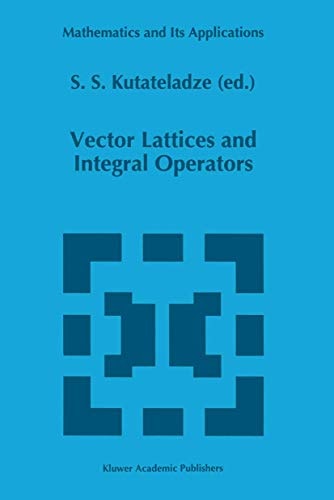
Vector Lattices and Intergal Operators
0
0
As an Amazon Associate and affiliate partner, Menrva Books earns from qualifying purchases. Learn more
Author Description
The theory of vector lattices, stemming from the mid-thirties, is now at the stage where its main achievements are being summarized. The sweeping changes of the last two decades have changed its image completely. The range of its application was expanded and enriched so as to embrace diverse branches of the theory of functions, geometry of Banach spaces, operator theory, convex analysis, etc. Furthermore, the theory of vector lattices was impregnated with principally new tools and techniques from other sections of mathematics. These circumstances gave rise to a series of mono graphs treating separate aspects of the theory and oriented to specialists. At the same time, the necessity of a book intended for a wider readership, reflecting the modern diretions of research became clear. The present book is meant to be an attempt at implementing this task. Although oriented to readers making their first acquaintance with vector-lattice theory, it is composed so that the main topics dealt with in the book reach the current level of research in the field, which is of interest and import for specialists. The monograph was conceived so as to be divisible into two parts that can be read independently of one another. The first part is mainly Chapter 1, devoted to the so-called Boolean-valued analysis of vector lattices. The term designates the applica tion of the theory of Boolean-valued models by D. Scott, R. Solovay and P.
Menrva's Summary
THE THESIS
This book aims to provide a comprehensive overview of vector lattice theory and its applications, bridging the gap between introductory concepts and current research frontiers. The author, S. S. Kutateladze, draws upon the significant advancements in the field over the past two decades, which have broadened its scope to include function theory, Banach space geometry, operator theory, and convex analysis. The text integrates new mathematical tools and techniques, presenting a modern perspective on the subject. It is structured to be accessible to newcomers while offering depth relevant to specialists, with a notable focus on Boolean-valued analysis in the first part.
THE SCOPE MAP
- Introduction to the theory of vector lattices and its historical development.
- Detailed exploration of Boolean-valued analysis as applied to vector lattices.
- Coverage of applications in diverse areas such as function theory and Banach spaces.
- Discussion of operator theory within the context of vector lattices.
- Integration of convex analysis principles.
- Presentation of modern research directions and techniques.
- Structure allowing for independent reading of its two main parts.
THE AUTHORITY PERSPECTIVE
The book is presented as an attempt to synthesize the recent developments in vector lattice theory for a wider audience, while still maintaining relevance for specialists. It aims to reflect the current state of research by incorporating new tools and techniques from various mathematical fields. The structure is designed to be accessible to those new to the theory, with the first part focusing on Boolean-valued analysis. This approach suggests a text that balances foundational knowledge with advanced topics.
Page Count:
471
Publication Date:
1996-01-31
Publisher:
Springer
ISBN-10:
0792338979
ISBN-13:
9780792338970
Science
Non-Fiction
Mathematics
Operator Theory
Functional analysis
Community Tags
Similar Books