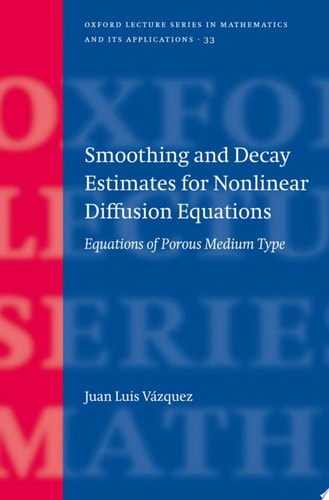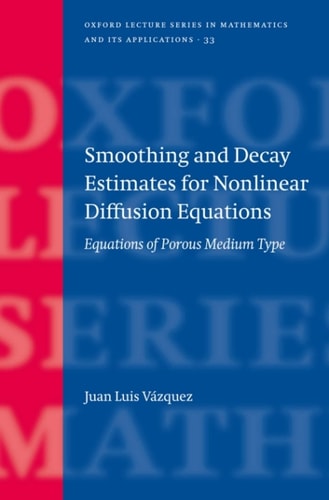
Smoothing and Decay Estimates for Nonlinear Diffusion Equations: Equations of Porous Medium Type
0
0
As an Amazon Associate and affiliate partner, Menrva Books earns from qualifying purchases. Learn more
Author Description
This text is concerned with the quantitative aspects of the theory of nonlinear diffusion equations; equations which can be seen as nonlinear variations of the classical heat equation. They appear as mathematical models in different branches of Physics, Chemistry, Biology, and Engineering, and are also relevant in differential geometry and relativistic physics. Much of the modern theory of such equations is based on estimates and functional analysis. Concentrating on a class of equations with nonlinearities of power type that lead to degenerate or singular parabolicity ("equations of porous medium type"), the aim of this text is to obtain sharp a priori estimates and decay rates for general classes of solutions in terms of estimates of particular problems. These estimates are the building blocks in understanding the qualitative theory, and the decay rates pave the way to the fine study of asymptotics. Many technically relevant questions are presented and analyzed in detail. A systematic picture of the most relevant phenomena is obtained for the equations under study, including time decay, smoothing, extinction in finite time, and delayed regularity.
Menrva's Summary
THE THESIS
This text investigates the quantitative properties of nonlinear diffusion equations of the porous medium type, focusing on how specific a priori estimates and decay rates characterize their solutions. Juan Luis Vázquez, a recognized authority in the field of partial differential equations, utilizes functional analysis to derive rigorous mathematical bounds for these degenerate and singular parabolic equations. The work establishes a systematic framework for understanding phenomena such as smoothing effects, extinction in finite time, and asymptotic behavior in various physical and biological models.
THE SCOPE MAP
What You Will Find
- Analysis of nonlinear diffusion equations with power-type nonlinearities
- Derivation of sharp a priori estimates and decay rates
- Examination of phenomena including extinction in finite time and delayed regularity
- Application of functional analysis techniques to parabolic equations
Scope Limits
- The text focuses specifically on equations of porous medium type rather than general nonlinear diffusion
- It assumes a high level of mathematical maturity and familiarity with partial differential equations
THE AUTHORITY PERSPECTIVE
Experts in the field of partial differential equations regard this work as a rigorous and comprehensive reference for researchers and graduate students. Readers frequently note the high level of technical density, which is expected given the specialized nature of the mathematical analysis presented.
Page Count:
248
Publication Date:
2006-01-01
Publisher:
Oxford University Press
ISBN-10:
0191525251
ISBN-13:
9780191525254
Mathematical Physics
Functional analysis
Nonlinear Diffusion
Mathematics Statistics
Mathematics
Mathematics - General