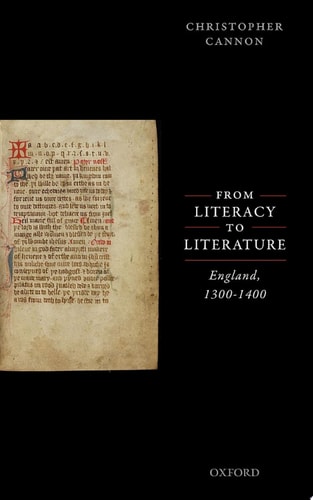
From Literacy to Literature: England, 1300-1400
0
0
As an Amazon Associate and affiliate partner, Menrva Books earns from qualifying purchases. Learn more
Author Description
The first lessons we learn in school can stay with us all our lives, but this was nowhere more true than in the last decades of the fourteenth century when grammar-school students were not only learning to read and write, but understanding, for the first time, that their mother tongue, English, was grammatical. The efflorescence of Ricardian poetry was not a direct result of this change, but it was everywhere shaped by it. This book characterizes this close connection between literacy training and literature, as it is manifest in the fine and ambitious poetry by Gower, Langland and Chaucer, at this transitional moment. This is also a book about the way medieval training in grammar (or grammatica) shaped the poetic arts in the Middle Ages fully as much as rhetorical training. It answers the curious question of what language was used to teach Latin grammar to the illiterate. It reveals, for the first time, what the surviving schoolbooks from the period actually contain. It describes what form a "grammar school" took in a period from which no school buildings or detailed descriptions survive. And it scrutinizes the processes of elementary learning with sufficient care to show that, for the grown medieval schoolboy, well-learned books functioned, not only as a touchstone for wisdom, but as a knowledge so personal and familiar that it was equivalent to what we would now call "experience."
Menrva's Summary
THE THESIS
This book investigates the fundamental connection between medieval grammar-school education and the emergence of Ricardian poetry in late fourteenth-century England. Christopher Cannon, a scholar of medieval literature, utilizes surviving schoolbooks and pedagogical records to argue that the formal study of Latin grammar provided the structural and intellectual framework for the poetic innovations of authors like Chaucer, Gower, and Langland. By examining the mechanics of elementary learning, the author demonstrates how the acquisition of literacy in the mother tongue transformed the medieval understanding of language and poetic art.
THE SCOPE MAP
What You Will Find
- Analysis of late fourteenth-century English grammar school curricula.
- Examination of surviving medieval schoolbooks and pedagogical texts.
- Theoretical framework linking 'grammatica' to the development of poetic arts.
- Case studies of Gower, Langland, and Chaucer.
Scope Limits
- The study is strictly confined to the English context between 1300 and 1400.
- It does not provide an exhaustive history of all medieval educational institutions.
THE AUTHORITY PERSPECTIVE
Scholars recognize this work as a significant contribution to the study of medieval literacy and its influence on vernacular literature. Readers frequently note the academic density of the prose, which provides a rigorous examination of primary source materials for specialists in the field.
Page Count:
297
Publication Date:
2016-01-01
Publisher:
Oxford University Press
ISBN-10:
0191824569
ISBN-13:
9780191824562
History
Linguistics
English literature
Literary Criticism
Education - History