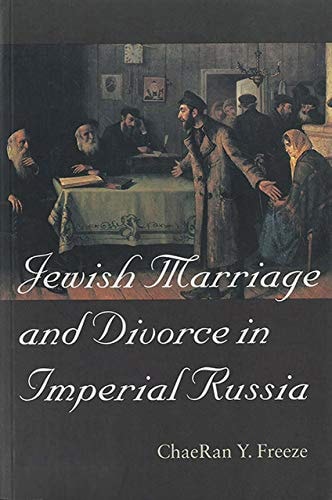
Jewish Marriage and Divorce in Imperial Russia
0
0
As an Amazon Associate and affiliate partner, Menrva Books earns from qualifying purchases. Learn more
Author Description
ChaeRan Freeze explores the impact of various forces on marriage and divorce among Jews in 19th-century Russia. Challenging romantic views of the Jewish family in the shtetl, she shows that divorce rates among Russian Jews in the first half of the century were astronomical compared to the non-Jewish population. Even more surprising is her conclusion that these divorce rates tended to drop later in the century, in contrast to the rising pattern among populations undergoing modernization. Freeze also studies the growing involvement of the Tsarist state. This occurred partly at the behest of Jewish women contesting patriarchy and parental power and partly because the government felt that Jewish families were in complete anarchy and in need of order and regulation. Extensive research in newly-declassified collections from twelve archives in Russia, Ukraine, and Lithuania enables Freeze to reconstruct Jewish patterns of marriage and divorce and to analyze the often conflicting interests of Jewish husbands and wives, rabbinic authorities, and the Russian state. Balancing archival resources with memoirs and printed sources in Hebrew, Yiddish, and Russian, she offers a tantalizing glimpse of the desires and travails of Jewish spouses, showing how individual life histories reflect the impact of modernization on Jewish matchmaking, gender relations, the "emancipation" of Jewish women, and the incursion of the Tsarist state into the lives of ordinary Jews.
Menrva's Summary
THE THESIS
The Tsarist state's increasing involvement in Jewish marital and divorce practices challenged traditional patriarchal structures and introduced new legal and social dynamics in 19th-century Russia. ChaeRan Freeze's research reveals surprisingly high divorce rates among Russian Jews in the first half of the century, a trend that reversed later in the century, contrary to modernization patterns elsewhere. This shift was influenced by Jewish women contesting patriarchal authority and the state's desire to regulate perceived anarchy within Jewish families. By synthesizing archival documents from Russia, Ukraine, and Lithuania with memoirs and printed sources in Hebrew, Yiddish, and Russian, Freeze reconstructs these complex patterns and analyzes the competing interests of spouses, rabbinic authorities, and the state.
THE SCOPE MAP
- Analysis of marriage and divorce patterns among Jews in 19th-century Russia.
- Examination of the impact of modernization on Jewish family structures and gender relations.
- Study of the role of Jewish women in contesting patriarchy and parental power.
- Investigation of the Tsarist state's intervention in Jewish family law and regulation.
- Reconstruction of Jewish marital and divorce practices using archival collections.
- Analysis of conflicting interests among Jewish husbands, wives, rabbinic authorities, and the Russian state.
- Use of primary sources in Hebrew, Yiddish, and Russian, alongside memoirs.
THE AUTHORITY PERSPECTIVE
The book challenges romanticized views of Jewish family life in the shtetl by presenting data on historically high divorce rates among Russian Jews in the 19th century. Freeze's conclusion that these rates declined later in the century, diverging from modernization trends, offers a nuanced perspective on social change. The study highlights the agency of Jewish women in navigating patriarchal structures and the state's role in imposing order. The extensive use of newly declassified archival materials provides a robust foundation for its analysis of individual life histories within broader societal shifts.
Page Count:
416
Publication Date:
2001-11-01
Publisher:
Brandeis University Press
ISBN-10:
1584651474
ISBN-13:
9781584651475
History
Non-Fiction
Family history
Jewish Studies
Social History
Gender Studies
Community Tags
Similar Books