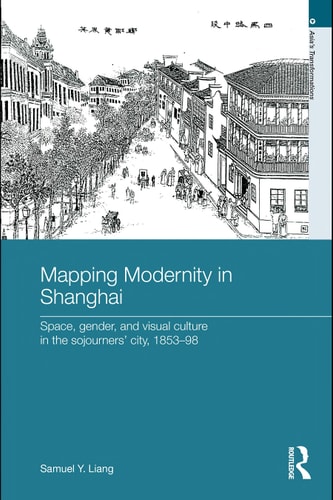
Mapping Modernity in Shanghai Space, Gender, and Visual Culture in the Sojourners' City, 1853-98
0
0
As an Amazon Associate and affiliate partner, Menrva Books earns from qualifying purchases. Learn more
Author Description
This book argues that modernity first arrived in late nineteenth-century Shanghai via a new spatial configuration. This cityâe(tm)s colonial capitalist development ruptured the traditional configuration of self-contained households, towns, and natural landscapes in a continuous spread, producing a new set of fragmented as well as fluid spaces. In this process, Chinese sojourners actively appropriated new concepts and technology rather than passively responding to Western influences. Liang maps the spatial and material existence of these transient people and reconstructs a cultural geography that spreads from the interior to the neighbourhood and public spaces. In this book the author: discusses the courtesan house as aãee surrogate home and analyzes its business, gender, and material configurations; examines a new type of residential neighbourhood and shows how its innovative spatial arrangements transformed the traditional social order and hierarchy; surveys a range of public spaces and highlights the mythic perceptions of industrial marvels, the adaptations of colonial spatial types, the emergence of an urban public, and the spatial fluidity between elites and masses. Through reading contemporaneous literary and visual sources, the book charts a hybrid modern development that stands in contrast to the positivist conception of modern progress. As such it will be a provocative read for scholars of Chinese cultural and architectural history.
Menrva's Summary
THE THESIS
This book investigates how modernity was first introduced to late nineteenth-century Shanghai through a radical reconfiguration of urban space. The author argues that Shanghai's colonial capitalist development shattered traditional spatial arrangements, creating fragmented yet fluid environments. Chinese sojourners, far from being passive recipients of Western influence, actively adopted new concepts and technologies, shaping their own cultural geography from domestic interiors to public spheres. The book examines the courtesan house as a surrogate home, analyzes new residential neighborhoods that transformed social orders, and surveys public spaces, highlighting perceptions of industrial marvels and the emergence of an urban public.
THE SCOPE MAP
- Analysis of the courtesan house as a surrogate home, detailing its business, gender, and material configurations.
- Examination of a new type of residential neighborhood and its innovative spatial arrangements that altered traditional social order and hierarchy.
- Survey of various public spaces, focusing on mythic perceptions of industrial marvels and adaptations of colonial spatial types.
- Exploration of the emergence of an urban public and the spatial fluidity between elites and masses.
- Reading of contemporaneous literary and visual sources to chart a hybrid modern development.
- Critique of the positivist conception of modern progress through the lens of Shanghai's development.
THE AUTHORITY PERSPECTIVE
This book is positioned as a provocative read for scholars of Chinese cultural and architectural history. The author's approach, which utilizes literary and visual sources to chart a hybrid modern development, stands in contrast to traditional positivist views of progress. The analysis of spatial configurations, gender, and visual culture in Shanghai offers a nuanced perspective on the reception and appropriation of modernity by Chinese sojourners. The detailed examination of specific urban spaces like courtesan houses and residential neighborhoods provides concrete examples to support its central thesis.
Page Count:
218
Publication Date:
2010-01-01
Publisher:
Routledge
ISBN-10:
0415569133
ISBN-13:
9780415569132
Non-Fiction
History
Architectural History
Urban History
Gender Studies
Cultural History
Chinese History
Community Tags
Similar Books