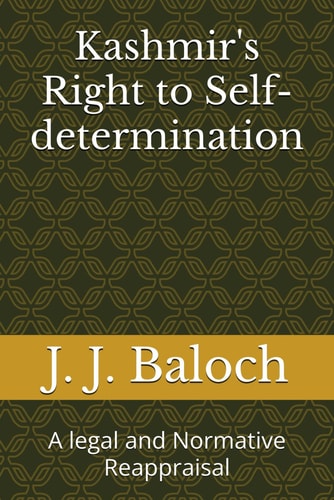
Kashmir's Right to Self-determination: A Legal and Normative Reappraisal
0
0
As an Amazon Associate and affiliate partner, Menrva Books earns from qualifying purchases. Learn more
Author Description
This study sheds light on the new post-cold-war democratic right to self-determination in Kashmir's case after India revoked its semi-autonomous status on 5 August 2019. The research will examine how the people of Kashmir qualify the legal and normative benchmarks for invoking their right to self-determination, using the concepts and variables of the struggle for the right to self-determination, denial of autonomy, violation of human rights, peoplehood, alien domination, illegal occupation, international community support for the referendum, and exhaustion of all available options. It attempts to find how remarkable changes have taken place in the legal and theoretical foundations of the doctrine of self-determination in international relations and law over seven decades. The new democratizing and peremptory nature of the right to self-determination and the factual situation of Kashmir in terms of the legal stance of occupying powers, priorities of peoples in Kashmir, and international geo-politics have led to this query. The case study of the revocation of the semi-autonomy status of Jammu and Kashmir by India on 5 August 2019 reveals that India has violated the Treaty of Accession (1948) and Delhi Agreements 1952. At Partition, India's governor general Mountbatten and Jawaharlal Nehru promised the Kashmiri people that the will of the Kashmiri people would settle the final political status, as provided in the Indian Independence Act 1947. The UNSC also endorsed the plebiscite through many UNSC Resolutions. The case of treaty violations falls within the international law of Self-determination. India's revoking the autonomous status of Kashmir raises several interesting questions about international law, namely statehood, self-determination, territorial integrity, and recognition. Many instruments of international law entitled "all peoples", including Kashmiris, to determine their political status, decide their political future, and pursue their economic, soci
Menrva's Summary
THE THESIS
This study reappraises the legal and normative basis for Kashmir's right to self-determination in the context of post-Cold War international relations and law. The research examines how the people of Kashmir meet the legal and normative benchmarks for invoking this right, considering factors such as the denial of autonomy, human rights violations, peoplehood, illegal occupation, and international support for a referendum. It analyzes significant shifts in the doctrine of self-determination over seven decades, particularly its democratizing and peremptory nature, in light of the factual situation in Kashmir and the legal stance of occupying powers. The revocation of Jammu and Kashmir's semi-autonomous status by India on August 5, 2019, is presented as a case study revealing violations of the Treaty of Accession (1948) and Delhi Agreements 1952, which promised the Kashmiri people that their will would determine the region's final political status.
THE SCOPE MAP
- Analysis of the post-Cold War democratic right to self-determination.
- Examination of legal and normative benchmarks for invoking self-determination in Kashmir.
- Concepts explored: struggle for self-determination, denial of autonomy, human rights violations, peoplehood, alien domination, illegal occupation, international community support for referendum, exhaustion of options.
- Historical review of the doctrine of self-determination in international relations and law over seven decades.
- Focus on the democratizing and peremptory nature of the right to self-determination.
- Case study: Revocation of semi-autonomy of Jammu and Kashmir by India on August 5, 2019.
- Examination of violations of the Treaty of Accession (1948) and Delhi Agreements 1952.
- Discussion of international law principles including statehood, self-determination, territorial integrity, and recognition.
THE AUTHORITY PERSPECTIVE
This work offers a detailed legal and normative reappraisal of Kashmir's right to self-determination, focusing on the implications of India's 2019 revocation of its semi-autonomous status. The study meticulously examines the legal and normative benchmarks relevant to Kashmir's claim, drawing on concepts such as peoplehood, illegal occupation, and international support for a referendum. It situates the case within the broader evolution of the doctrine of self-determination in international law over the past seventy years. The author's analysis highlights alleged violations of key treaties and agreements, underscoring the complex interplay of international law, statehood, territorial integrity, and recognition in the context of the Kashmir dispute.
Page Count:
230
Publication Date:
2023-08-14
Publisher:
Amazon Digital Services LLC - Kdp
ISBN-13:
9798859950836
Non-Fiction
History
Politics
International Law
Human rights
Community Tags
Similar Books