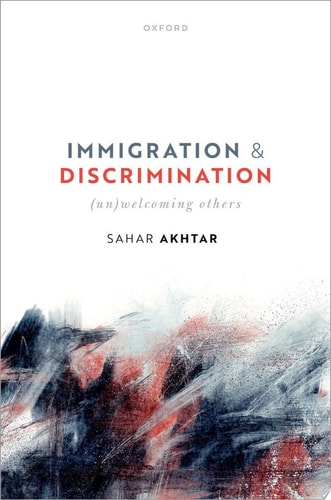
Immigration And Discrimination: (un)welcoming Others
0
0
As an Amazon Associate and affiliate partner, Menrva Books earns from qualifying purchases. Learn more
Author Description
Cover -- Immigration And Discrimination: (un)welcoming Others -- Copyright -- Contents -- Preface And Acknowledgments -- Introduction: Immigration And Identity -- 1. Race, Ethnicity, And Religion Take Center Stage -- 2. The Argument Of This Book -- 3. Chapter Outlines -- 1: Race, Ethnicity, And Religion Under States' Choice -- 1. Introduction -- 2. Some Cases And Terminology -- 3. States' Choice -- 3.1 Culture -- 3.2 Association -- 4. Why Discrimination, And Why Antidiscrimination? -- 2: Core Elements Of Antidiscrimination -- 1. Introduction -- 2. Wrongful Discrimination 3. Antidiscrimination -- 4. Antidiscrimination And Relational Equality -- 5. Are Such Concerns Restricted To The Domestic Context? -- 3: Race, Ethnicity, And Religion In The Global Context -- 1. Introduction -- 2. Global Status: An Initial Description -- 3. Global Status: Refining The Idea -- 4. How Does Global Status Matter? -- 5. Domestic Status And Differentiating Among Cases -- 6. Explaining Navajo And Other Hypothetical Cases -- 7. How Global Status Explains Real Cases -- 4: Global Antidiscrimination Duties -- 1. Introduction -- 2. Antidiscrimination Sites 3. States As Antidiscrimination Sites -- 4. Global Status And Global Relations -- 5. Contributing To Collective Goods And Incurring Obligations -- 6. The Plausibility Of The Primary Duties: Revisiting The Wrong To Members View -- 5: The Primary Duties -- 1. Introduction -- 2. Recap And Terminology -- 3. Do Racial Or Ethnic Criteria Always Violate The Primary Duties? -- 4. Role Of Region And Type Of Disadvantage -- 4.1 The Excluded Group(s) -- 4.2 The Admitting Group -- 4.3 The Role Of Shared Region -- 5. The Primary Duties And Other Identities -- 6. Antidiscrimination, Not Corrective Justice 6: Between The Primary Duties And Open Borders -- 1. Introduction -- 2. Non-identity Criteria -- 3. Further Antidiscrimination Duties -- 3.1 Duties Not To Selectively Exclude When It Contributes To Disadvantages -- 3.2 Antidiscrimination Duties To The Poo
Menrva's Summary
THE THESIS
This book investigates the moral legitimacy of using race, ethnicity, and religion as criteria for immigration selection and the resulting obligations of states to uphold antidiscrimination principles. Sahar Akhtar, a scholar in political philosophy, utilizes a framework of relational equality to analyze how domestic and global status influence immigration policy. The text argues that states possess specific duties to avoid discriminatory practices that exacerbate global inequalities, challenging the traditional view that sovereign states have absolute discretion in border control.
THE SCOPE MAP
What You Will Find
- A philosophical framework for evaluating state immigration policies based on antidiscrimination duties.
- Analysis of how global status and regional disadvantage impact the ethics of exclusion.
- Theoretical distinctions between domestic and global antidiscrimination obligations.
Scope Limits
- The text does not provide a comprehensive legal manual for current immigration law.
- It does not offer a definitive policy blueprint for open borders or specific legislative reform.
THE AUTHORITY PERSPECTIVE
Scholars in political theory and ethics view this work as a rigorous contribution to the debate on state sovereignty versus human rights. Readers frequently note the academic density of the prose, which requires a background in political philosophy to fully grasp the nuanced arguments presented.
Page Count:
0
Publication Date:
2024-01-01
Publisher:
New York : Oxford University Press,
ISBN-10:
0191999784
ISBN-13:
9780191999789
Philosophy
Immigration Policy
Human rights
Ethics
Sociology
Discrimination
Community Tags
Other Editions(2)
Similar Books















Reader Comments
Share Your Thoughts
No comments yet. Be the first to share your thoughts!