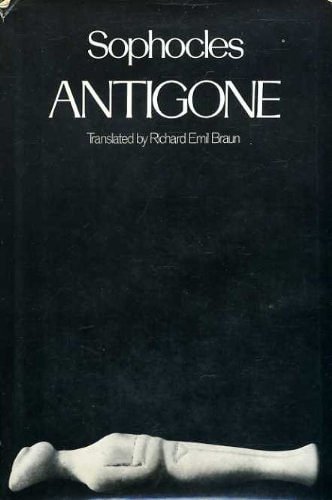
Antigone
0
0
As an Amazon Associate and affiliate partner, Menrva Books earns from qualifying purchases. Learn more
Author Description
Based on the conviction that only translators who write poetry themselves can properly recreate the celebrated and timeless tragedies of Aeschylus, Sophocles, and Euripides, the Greek Tragedy in New Translations series offers new translations that go beyond the literal meaning of the Greek in order to evoke the poetry of the originals. The series seeks to recover the entire extant corpus of Greek tragedy, quite as though the ancient tragedians wrote in the English of our own time. Under the editorship of Peter Burian and Alan Shapiro, each of these volumes includes a critical introduction, commentary on the text, full stage directions, and a glossary of the mythical and geographical references in the plays. This finely-tuned translation of Sophocles' Antigone by Richard Emil Braun, both a distinguished poet and a professional scholar-critic, offers, in lean, sinewy verse and lyrics of unusual intensity, an interpretation informed by exemplary scholarship and critical insight. Braun presents an Antigone not marred by excessive sentimentality or pietistic attitudes. His translation underscores the extraordinary structural symmetry and beauty of Sophocles' design by focusing on the balanced and harmonious view of tragically opposed wills that makes the play so moving. Unlike the traditionally gentle and pious protagonist opposed to a brutal and villainous Creon, Braun's Antigone emerges as a true Sophoclean heroine--with all the harshness and even hubris, as well as pathos and beauty, that Sophoclean heroism requires. Braun also reveals a Creon as stubbornly principled as Antigone, instead of simply the arrogant tyrant of conventional interpretations.
Menrva's Summary
THE PULSE
Antigone defies the royal decree of King Creon to bury her brother, setting in motion a fatal collision between divine law and state authority. Antigone seeks to fulfill her familial and religious obligations by performing funeral rites for Polyneices, an act explicitly forbidden by the new ruler of Thebes. She faces the absolute power of the state and the rigid, uncompromising nature of Creon, who views her disobedience as a direct threat to the stability of his reign. The narrative unfolds through the structured dialogue and choral odes characteristic of classical Greek drama, emphasizing the inevitable progression toward catastrophe.
INSIDE THE PAGES
- Verse-based translation focusing on poetic rhythm and intensity
- Inclusion of critical introduction and scholarly commentary
- Detailed stage directions for performance
- Glossary of mythical and geographical references
- Characterization of Antigone as a complex, flawed heroine
- Reinterpretation of Creon as a principled rather than purely villainous figure
- Emphasis on structural symmetry and thematic balance
- Exploration of the conflict between individual conscience and civic law
THE COLLECTIVE ECHO
Discussion often centers on the specific stylistic choices made by Richard Emil Braun to move away from traditional, sentimental interpretations of the play. Readers frequently highlight the lean, sinewy quality of the verse, which aims to capture the original Greek intensity without relying on archaic language. Critics note that the translation successfully presents a more nuanced view of the central conflict, avoiding the common trope of a purely virtuous protagonist against a one-dimensional tyrant. The inclusion of scholarly apparatus makes this edition particularly useful for those interested in the structural design and historical context of Sophoclean tragedy.
Page Count:
116
Publication Date:
1974-01-01
Publisher:
Oxford UP
ISBN-10:
0192125729
ISBN-13:
9780192125729
Drama
Poetry
Plays
Greek
Classical
Dramas & Plays
Greek Tragedy
Community Tags
Similar Books