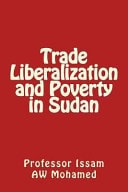
Trade Liberalization and Poverty in Sudan
0
0
As an Amazon Associate and affiliate partner, Menrva Books earns from qualifying purchases. Learn more
Author Description
The book delves into two basic problems concerning the effects of involvement in the world trade liberalization on poverty in Sudan. The first problem is how to select the suitable indicator to measure poverty in Sudan, especially as the previous ones were said to be invalid and they need statistical methods to amend the lost values. The second one has something to do with the nature of the data used for measuring poverty in Sudan, which severely suffer from the Autoregressive Conditional Heteroskdasitcity (ACH) phenomenon. That simply means unstable periods. Data were collected about poverty based on the estimation of the World Bank development index in Sudan. Sudan imports materials were use by COMESA to imply the trade liberalizing indicators. Auto Regressive and moving Average (ARI) to show the missed data of the period of human development index. Then (GRACH) model was used to measure the relation ship between trade liberalization and poverty in Sudan. The basic idea relies on the use of Generalized Autoregressive Conditional Heteroskedasticity, which is the first time to model poverty and trade in the Sudan. The model has a great ability in dealing with data which shows sharp fluctuations in some periods and stability in other periods. The Study includes extensive literature review, results and recommendations.
Menrva's Summary
THE THESIS
This book investigates the complex relationship between global trade liberalization and poverty levels within Sudan. The study addresses two core challenges: selecting appropriate poverty indicators for Sudan, given previous invalid measures and missing data, and accounting for the Autoregressive Conditional Heteroskedasticity (ACH) phenomenon in the available data, which signifies periods of instability. Utilizing World Bank development index data and COMESA import materials, the authors employ Auto Regressive and Moving Average (ARI) and Generalized Autoregressive Conditional Heteroskedasticity (GRACH) models to analyze the link between trade liberalization and poverty, marking a novel approach for modeling these factors in Sudan.
THE SCOPE MAP
- Analysis of poverty measurement indicators in Sudan, addressing issues of validity and missing data.
- Application of statistical methods, including ARI and GRACH models, to account for Autoregressive Conditional Heteroskedasticity (ACH) in economic data.
- Examination of the impact of trade liberalization on poverty using data derived from the World Bank development index and COMESA import materials.
- A comprehensive literature review on trade liberalization and poverty.
- Presentation of study results and actionable recommendations for policy.
THE AUTHORITY PERSPECTIVE
This book presents a rigorous econometric analysis of trade liberalization's impact on poverty in Sudan, employing advanced statistical models like GRACH to address data complexities. The study's novelty lies in its specific application to the Sudanese context, aiming to provide a more accurate measurement of poverty and its relationship with international trade policies. The inclusion of an extensive literature review and policy recommendations suggests a comprehensive approach intended for academics, policymakers, and development economists interested in the Sudanese economy.
Page Count:
438
Publication Date:
2012-10-25
Publisher:
CreateSpace Independent Publishing Platform
ISBN-10:
1480168807
ISBN-13:
9781480168800
Non-Fiction
Economics
Trade Policy
Sudan
Community Tags
Similar Books