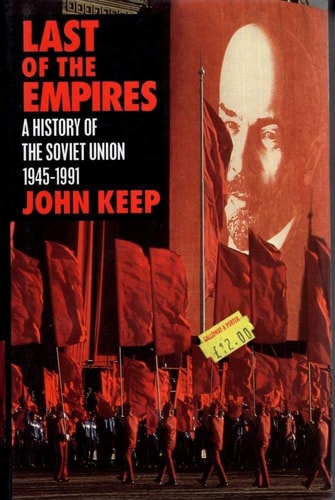
Last of the Empires: A History of the Soviet Union, 1945-1991
0
0
As an Amazon Associate and affiliate partner, Menrva Books earns from qualifying purchases. Learn more
Author Description
Designed with the general reader in mind, this clearly written narrative history of the Soviet Union from the end of World War II to its collapse in 1991 provides an integrated introduction to the "Last of the Empires." There were more than one hundred nationalities in the USSR; Keep deals with those that held union-republic status, especially the Baltic peoples and those of Central Asia. His approach is to exclude foreign affairs and defense policy, emphasizing instead the central themes of political, economic, social, and cultural development with a good deal of attention paid to the key problem of inter-ethnic relations.The story begins with the last years of Stalin's despotic rule. Keep does not explore the origins of Stalinism, which have been fully treated elsewhere, but treats these years as the introduction to the comparatively optimistic era of Khrushchev. Under his leadership Communist rule was reformed, though not necessarily liberalized, and there was an overall relaxation of police terror and an improvement in living standards. Keep shows how the ensuing Brezhnev years brought greater material prosperity but marked a setback to popular aspirations for change in other respects. Yet it was in these years that official ideology became less relevant than ever to people's everyday concerns; Keep argues that the Party lost moral authority due to internal corruption, and that the system gradually eroded. Finally, the younger and more pragmatic leadership symbolized by Gorbachev took over. The fate of their reform policies is the subject of the book's final chapters, which delineate how central institutions crumbled as national minorities claimed their rights and centrifugal pressures brought about the empire's collapse. Making use of a broad literature of "sovietological" expertise along with the new information that has become available since Soviet secrecy was relaxed in 1988, Last of the Empires sums up what is now known about postwar Soviet history and pre
Menrva's Summary
THE THESIS
This book investigates the internal political, economic, and social mechanisms that led to the dissolution of the Soviet Union between 1945 and 1991. John L. H. Keep, an established historian of the Soviet era, utilizes a synthesis of existing sovietological literature and newly accessible archival information from the late 1980s. He argues that the erosion of the Communist Party's moral authority, coupled with internal corruption and rising ethnic nationalism, rendered the Soviet system unsustainable despite attempts at reform.
THE SCOPE MAP
What You Will Find
- Analysis of domestic policy, economic development, and social shifts within the USSR.
- Examination of inter-ethnic relations among the union-republics, specifically Baltic and Central Asian populations.
- A chronological narrative spanning from the late Stalinist period through the Khrushchev, Brezhnev, and Gorbachev eras.
Scope Limits
- The text explicitly excludes detailed coverage of foreign affairs and defense policy.
- It does not provide an in-depth exploration of the origins of Stalinism, focusing instead on the postwar period.
THE AUTHORITY PERSPECTIVE
Experts recognize this work as a balanced and accessible introduction to the internal dynamics of the late Soviet state. Readers frequently note that the author's focus on domestic social and ethnic issues provides a necessary counterpoint to traditional histories that prioritize Cold War geopolitics.
Page Count:
496
Publication Date:
1995-07-27
Publisher:
Oxford University Press
ISBN-10:
0192192558
ISBN-13:
9780192192554
History
20th Century
International relations
Soviet Union
Community Tags
Other Editions(2)
Similar Books


Reader Comments
Share Your Thoughts
No comments yet. Be the first to share your thoughts!