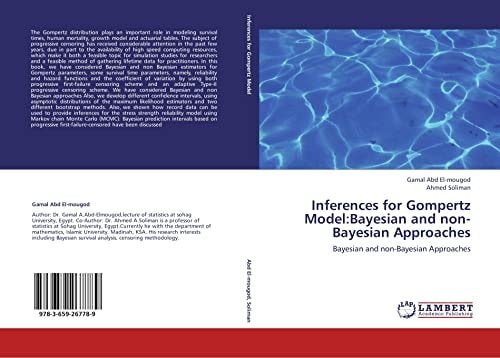
Inferences for Gompertz Model: Bayesian and Non-Bayesian Approaches
0
0
As an Amazon Associate and affiliate partner, Menrva Books earns from qualifying purchases. Learn more
Author Description
The Gompertz distribution plays an important role in modeling survival times, human mortality, growth model and actuarial tables. The subject of progressive censoring has received considerable attention in the past few years, due in part to the availability of high speed computing resources, which make it both a feasible topic for simulation studies for researchers and a feasible method of gathering lifetime data for practitioners. In this book, we have considered Bayesian and non Bayesian estimators for Gompertz parameters, some survival time parameters, namely, reliability and hazard functions and the coefficient of variation by using both progressive first-failure censoring scheme and an adaptive Type-II progressive censoring scheme. We have considered Bayesian and non Bayesian approaches Also, we develop different confidence intervals, using asymptotic distributions of the maximum likelihood estimators and two different bootstrap methods. Also, we shown how record data can be used to provide inferences for the stress strength reliability model using Markov chain Monte Carlo (MCMC). Bayesian prediction intervals based on progressive first-failure-censored have been discussed
Menrva's Summary
THE THESIS
This book investigates the application of Bayesian and non-Bayesian estimation techniques to the Gompertz distribution, a model crucial for survival times, mortality, and growth analysis. The authors explore parameter estimation using progressive first-failure censoring and adaptive Type-II progressive censoring schemes. They also develop confidence intervals through maximum likelihood estimators and bootstrap methods, and discuss inferences for stress-strength reliability models using Markov chain Monte Carlo (MCMC). Bayesian prediction intervals for progressive first-failure-censored data are also examined.
THE SCOPE MAP
- Bayesian and non-Bayesian estimators for Gompertz parameters.
- Analysis of survival time parameters including reliability and hazard functions.
- Estimation of the coefficient of variation.
- Application of progressive first-failure censoring scheme.
- Application of adaptive Type-II progressive censoring scheme.
- Development of confidence intervals using asymptotic distributions and bootstrap methods.
- Inferences for stress-strength reliability model using Markov chain Monte Carlo (MCMC).
- Discussion of Bayesian prediction intervals based on progressive first-failure-censored data.
THE AUTHORITY PERSPECTIVE
The book presents a detailed exploration of statistical inference methods applied to the Gompertz distribution, a significant model in actuarial science and survival analysis. It covers both classical and Bayesian approaches to parameter estimation and confidence interval construction, utilizing advanced censoring schemes and computational techniques like MCMC. The work is likely to be of interest to researchers and practitioners in statistics, reliability engineering, and actuarial science seeking rigorous methods for analyzing lifetime data.
Page Count:
192
Publication Date:
2012-10-01
Publisher:
LAP LAMBERT Academic Publishing
ISBN-10:
3659267783
ISBN-13:
9783659267789
Science
Non-Fiction
Statistics
Probability
Community Tags
Similar Books