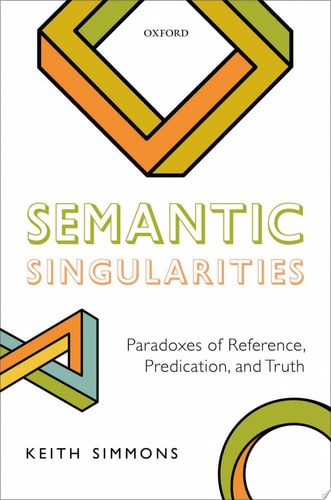
Semantic Singularities
0
0
As an Amazon Associate and affiliate partner, Menrva Books earns from qualifying purchases. Learn more
Author Description
This Book Aims To Provide A Solution To The Semantic Paradoxes. It Argues For A Unified Solution To The Paradoxes Generated By Our Concepts Of Denotation, Predicate Extension, And Truth. The Solution Makes Two Main Claims. The First Is That Our Semantic Expressions 'denotes', 'extension' And 'true' Are Context-sensitive. The Second, Inspired By A Brief, Tantalizing Remark Of Gödel's, Is That These Expressions Are Significant Everywhere Except For Certain Singularities, In Analogy With Division By Zero. A Formal Theory Of Singularities Is Presented And Applied To A Wide Variety Of Versions Of The Definability Paradoxes, Russell's Paradox, And The Liar Paradox. Keith Simmons Argues That The Singularity Theory Satisfies The Following Desiderata: It Recognizes That The Proper Setting Of The Semantic Paradoxes Is Natural Language, Not Regimented Formal Languages; It Minimizes Any Revision To Our Semantic Concepts; It Respects As Far As Possible Tarski's Intuition That Natural Languages Are Universal; It Responds Adequately To The Threat Of Revenge Paradoxes; And It Preserves Classical Logic And Semantics. Simmons Draws Out The Consequences Of The Singularity Theory For Deflationary Views Of Our Semantic Concepts, And Concludes That If We Accept The Singularity Theory, We Must Reject Deflationism.
Menrva's Summary
THE THESIS
This book investigates the nature of semantic paradoxes by proposing a unified theory centered on the context-sensitivity of semantic expressions. Keith Simmons, a philosopher specializing in the philosophy of language and logic, utilizes a formal framework to address long-standing issues surrounding truth, denotation, and predicate extension. By drawing an analogy between semantic expressions and mathematical division by zero, he argues that these concepts function reliably in most contexts but encounter specific, identifiable singularities that generate paradoxes.
THE SCOPE MAP
What You Will Find
- A formal theory of singularities applied to the Liar Paradox, Russell's Paradox, and various definability paradoxes.
- An analysis of the context-sensitivity of terms such as 'denotes', 'extension', and 'true'.
- A critique of deflationary views regarding semantic concepts.
Scope Limits
- The text does not provide a comprehensive history of all logical paradoxes.
- The work focuses primarily on the author's specific singularity theory rather than an exhaustive survey of competing non-classical logical solutions.
THE AUTHORITY PERSPECTIVE
Experts in the philosophy of language recognize this work as a significant contribution to the ongoing debate regarding the universality of natural language and the resolution of semantic paradoxes. Readers frequently note the technical density of the prose, which requires a strong background in formal logic and analytic philosophy to fully grasp the proposed framework.
Page Count:
272
Publication Date:
2018-01-01
Publisher:
Oxford University Press
ISBN-10:
0192509195
ISBN-13:
9780192509192
Philosophy
Logic
Semantics
Philosophy of
Metaphysics