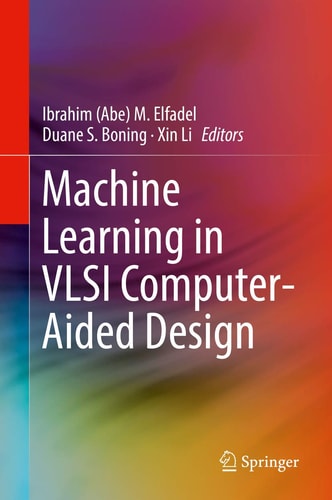
Machine Learning in VLSI Computer-Aided Design
0
0
As an Amazon Associate and affiliate partner, Menrva Books earns from qualifying purchases. Learn more
Author Description
This book provides readers with an up-to-date account of the use of machine learning frameworks, methodologies, algorithms and techniques in the context of computer-aided design (CAD) for very-large-scale integrated circuits (VLSI). Coverage includes the various machine learning methods used in lithography, physical design, yield prediction, post-silicon performance analysis, reliability and failure analysis, power and thermal analysis, analog design, logic synthesis, verification, and neuromorphic design. Provides up-to-date information on machine learning in VLSI CAD for device modeling, layout verifications, yield prediction, post-silicon validation, and reliability; Discusses the use of machine learning techniques in the context of analog and digital synthesis; Demonstrates how to formulate VLSI CAD objectives as machine learning problems and provides a comprehensive treatment of their efficient solutions; Discusses the tradeoff between the cost of collecting data and prediction accuracy and provides a methodology for using prior data to reduce cost of data collection in the design, testing and validation of both analog and digital VLSI designs. From the Foreword As the semiconductor industry embraces the rising swell of cognitive systems and edge intelligence, this book could serve as a harbinger and example of the osmosis that will exist between our cognitive structures and methods, on the one hand, and the hardware architectures and technologies that will support them, on the other....As we transition from the computing era to the cognitive one, it behooves us to remember the success story of VLSI CAD and to earnestly seek the help of the invisible hand so that our future cognitive systems are used to design more powerful cognitive systems. This book is very much aligned with this on-going transition from computing to cognition, and it is with deep pleasure tha
Menrva's Summary
THE THESIS
This book investigates the integration of machine learning frameworks and methodologies within the domain of computer-aided design (CAD) for very-large-scale integrated circuits (VLSI). It addresses the critical need for advanced techniques to manage the increasing complexity of semiconductor design, covering a wide array of applications from device modeling and lithography to post-silicon analysis and neuromorphic design. The authors explore how to translate VLSI CAD objectives into machine learning problems, offering efficient solutions and discussing the trade-offs between data collection costs and prediction accuracy. The book also examines the use of prior data to reduce costs in the design, testing, and validation of both analog and digital VLSI systems.
THE SCOPE MAP
- Machine learning methods applied to lithography, physical design, and yield prediction.
- Coverage of post-silicon performance analysis, reliability, and failure analysis.
- Discussion of machine learning in power and thermal analysis, and analog/digital synthesis.
- Formulation of VLSI CAD objectives as machine learning problems with efficient solutions.
- Methodology for using prior data to reduce data collection costs in design, testing, and validation.
- Applications in verification and neuromorphic design.
THE AUTHORITY PERSPECTIVE
This book is positioned as a comprehensive and up-to-date resource for professionals and researchers in VLSI CAD and machine learning. Its detailed coverage of diverse applications and practical methodologies suggests it serves as a valuable reference for understanding the current state and future directions of the field. The foreword highlights its relevance to the industry's transition towards cognitive systems, underscoring its forward-looking perspective.
Page Count:
694
Publication Date:
2019-03-27
Publisher:
Springer International Publishing
ISBN-10:
3030046656
ISBN-13:
9783030046651
Science
Non-Fiction
Community Tags
Similar Books















Reader Comments
Share Your Thoughts
No comments yet. Be the first to share your thoughts!