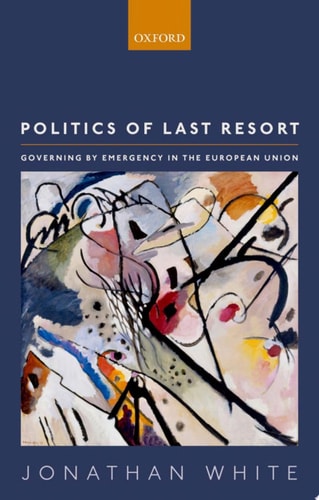
Politics of Last Resort
0
0
As an Amazon Associate and affiliate partner, Menrva Books earns from qualifying purchases. Learn more
Author Description
Prominent in the EU's recent transformations has been the tendency to advance extraordinary measures in the name of crisis response. From emergency lending to macro-economics, border management to Brexit, policies are pursued unconventionally and as measures of last resort. This book investigates the nature, rise, and implications of this politics of emergency as it appears in the transnational setting. As the author argues, recourse to this method of rule is an expression of the deeper weakness of executive power in today's Europe. It is how policy-makers contend with rising socio-economic power and diminishing representative ties, seeking fall-back authority in the management of crises. In the structure of the EU they find incentives and few impediments. Whereas political exceptionalism tends to be associated with sovereign power, here it is power's diffusion and functional disaggregation that spurs politics in the emergency mode. The effect of these governing patterns is not just to challenge and reshape ideas of EU legitimacy rooted in constitutionalism and technocracy. The politics of emergency fosters a counter-politics in its mirror image, as populists and others play with themes of necessity and claim the right to disobedience in extremis. The book examines the prospects for democracy once the politics of emergency takes hold, and what it might mean to put transnational politics on a different footing.
Menrva's Summary
THE THESIS
This book investigates the nature, rise, and implications of the politics of emergency as a governing mode within the transnational setting of the European Union. Jonathan White, a professor of politics, utilizes historical analysis and political theory to argue that the frequent recourse to extraordinary measures reflects a fundamental weakness in contemporary executive power. He posits that policy-makers adopt this method to compensate for diminishing representative ties and socio-economic instability, ultimately reshaping the legitimacy of the European project.
THE SCOPE MAP
What You Will Find
- Analysis of crisis response mechanisms including emergency lending, macro-economics, and border management.
- Examination of the relationship between executive power, technocracy, and constitutionalism.
- Investigation into the rise of counter-politics and populist responses to emergency governance.
Scope Limits
- The analysis is primarily focused on the transnational structure of the European Union rather than individual member state domestic politics.
- The text does not provide a comprehensive policy manual for crisis management but rather a theoretical critique of the governing mode.
THE AUTHORITY PERSPECTIVE
Scholars and political analysts recognize this work as a significant contribution to the study of European integration and the erosion of democratic norms. Readers frequently note the academic density of the prose, which is well-suited for students and researchers of political theory and institutional governance.
Page Count:
256
Publication Date:
2019-01-01
Publisher:
Oxford University Press
ISBN-10:
0192509462
ISBN-13:
9780192509468
International relations
Political Theory
European Union
Governance
Community Tags
Similar Books