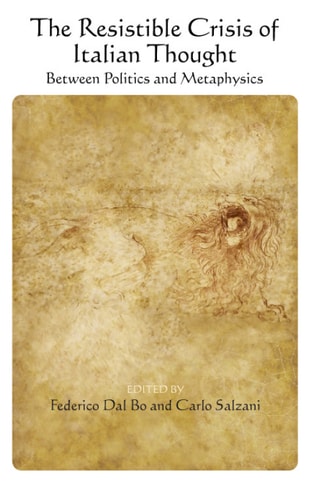
The Resistible Crisis of Italian Thought
0
0
As an Amazon Associate and affiliate partner, Menrva Books earns from qualifying purchases. Learn more
Author Description
Offers a more complex picture of Roberto Esposito's notion of "Italian Thought" in order to examine the persisting crisis of contemporary Italian philosophy. The present volume intends to offer new insight into Roberto Esposito's seminal notion of "Italian Thought." In Esposito's understanding, Italian Thought would offer an innovative bridge between French and German philosophy. As distinguished from French postmodernism and German transcendentalism in communication ethics, Italian Thought would allow for a better negotiation between power, history, and life. The essays within The Resistible Crisis of Italian Thought do not share Esposito's optimism but rather argue that the fascinating notion of Italian Thought unfortunately only provides a selective representation and neglects several portions of it, such as Italian metaphysicians, political scientists, feminists, and art theorists. Motivated by the ambition to address this neglect and to offer a more complex insight that does not necessarily end with the reassuring representation offered by Esposito, this volume points us toward an examination of the persisting crisis of contemporary Italian philosophy.
Menrva's Summary
THE THESIS
This volume critically examines Roberto Esposito's concept of 'Italian Thought' to understand the ongoing crisis in contemporary Italian philosophy. The book challenges Esposito's optimistic view that Italian Thought uniquely bridges French and German philosophy, arguing instead that it presents a selective representation that omits significant contributions from metaphysicians, political scientists, feminists, and art theorists. By addressing these omissions, the essays aim to provide a more nuanced and complex insight into the field, moving beyond Esposito's reassuring framework to confront the persistent challenges within Italian philosophical discourse.
THE SCOPE MAP
- An in-depth analysis of Roberto Esposito's concept of 'Italian Thought'.
- Examination of the crisis in contemporary Italian philosophy.
- Critiques of Esposito's notion, highlighting neglected areas.
- Exploration of contributions from Italian metaphysicians.
- Discussion of Italian political scientists and their impact.
- Inclusion of feminist and art theorists within Italian philosophical discourse.
- A re-evaluation of the relationship between French, German, and Italian philosophy.
THE AUTHORITY PERSPECTIVE
This collection critically engages with Roberto Esposito's influential concept of 'Italian Thought,' offering a counterpoint to his optimistic synthesis of French and German philosophical traditions. The essays collectively argue that Esposito's framework is selective, overlooking crucial contributions from various Italian thinkers. The volume's strength lies in its detailed examination of these neglected areas, including metaphysics, political science, feminism, and art theory, thereby providing a more comprehensive understanding of contemporary Italian philosophy's challenges. This work is positioned to stimulate further debate on the scope and limitations of 'Italian Thought' and its role in the broader philosophical landscape.
Page Count:
288
Publication Date:
2026-02-01
Publisher:
State University of New York Press (SUNY Press)
ISBN-13:
9798855807042
Non-Fiction
Philosophy
Metaphysics
Political Philosophy
European Philosophy
Art Theory
Feminist Philosophy
Community Tags
Similar Books