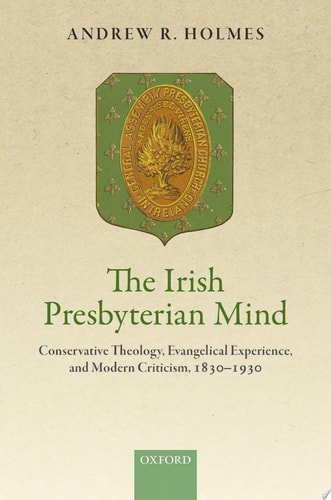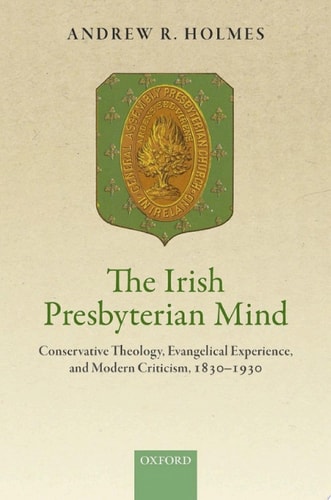
The Irish Presbyterian Mind: Conservative Theology, Evangelical Experience, and Modern Criticism, 1830-1930
0
0
Author Description
The Irish Presbyterian Mind considers how one protestant community responded to the challenges posed to traditional understandings of Christian faith between 1830 and 1930. Andrew R. Holmes examines the attitudes of the leaders of the Presbyterian Church in Ireland to biblical criticism, modern historical method, evolutionary science, and liberal forms of protestant theology. He explores how they reacted to developments in other Christian traditions, including the so-called 'Romeward' trend in the established Churches of England and Ireland and the 'Romanisation' of Catholicism. Was their response distinctively Presbyterian and Irish? How was it shaped by Presbyterian values, intellectual first principles, international denominational networks, identity politics, the expansion of higher education, and relations with other Christian denominations? The story begins in the 1830s when evangelicalism came to dominate mainstream Presbyterianism, the largest protestant denomination in present-day Northern Ireland. It ends in the 1920s with the exoneration of J. E. Davey, a professor in the Presbyterian College, Belfast, who was tried for heresy on accusations of being a 'modernist'. Within this timeframe, Holmes describes the formation and maintenance of a religiously-conservative intellectual community. At the heart of the interpretation is the interplay between the Reformed theology of the Westminster Confession of Faith and a commitment to common evangelical principles and religious experience that drew protestants together from various denominations. The definition of conservative within the Presbyterian Church in Ireland moved between these two poles and could take on different forms depending on time, geography, social class, and whether the individual was a minister or a member of the laity.
Menrva's Summary
THE THESIS
How did the Irish Presbyterian community navigate the tension between traditional Reformed theology and the intellectual pressures of modernity between 1830 and 1930? Andrew R. Holmes, a scholar of Irish religious history, utilizes extensive archival research and denominational records to analyze the intellectual development of the Presbyterian Church in Ireland. He argues that the community maintained a conservative identity by balancing the rigid requirements of the Westminster Confession of Faith with broader evangelical experiences. This framework illustrates how internal theological debates and external social pressures shaped the church's response to modern criticism and scientific advancement.
THE SCOPE MAP
What You Will Find
- Analysis of the impact of biblical criticism and evolutionary science on Irish Presbyterian thought.
- Examination of the 1920s heresy trial of J. E. Davey as a case study for modernism.
- Exploration of the influence of international denominational networks and identity politics.
Scope Limits
- The study is geographically confined to the Presbyterian Church in Ireland.
- The analysis focuses primarily on the intellectual and theological leadership rather than the entirety of the lay population.
THE AUTHORITY PERSPECTIVE
Historians and theologians recognize this work as a definitive account of the intellectual climate within Irish Presbyterianism during a century of significant transition. Scholars frequently cite the book for its rigorous archival methodology and its nuanced treatment of the interplay between conservative theology and modern academic criticism.
Page Count:
304
Publication Date:
2018-01-01
Publisher:
OUP Oxford
ISBN-10:
0192512234
ISBN-13:
9780192512239
Religion
History
Ireland
Theology
Intellectual History
Presbyterianism
Community Tags
Similar Books