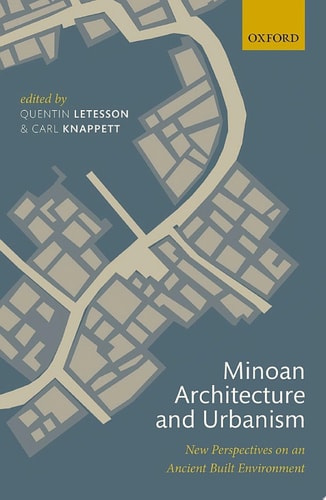
Minoan Architecture and Urbanism: New Perspectives on an Ancient Built Environment
Author Description
Minoan Crete is rightly famous for its idiosyncratic architecture, as well as its palaces and towns such as Knossos, Malia, Gournia, and Palaikastro. Indeed, these are often described as the first urban settlements of Bronze Age Europe. However, we still know relatively little about the dynamics of these early urban centres. How did they work? What role did the palaces have in their towns, and the towns in their landscapes? It might seem that with such richly documented architectural remains these questions would have been answered long ago. Yet, analysis has mostly found itself confined to building materials and techniques, basic formal descriptions, and functional evaluations. Critical evaluation of these data as constituting a dynamic built environment has thus been slow in coming. This volume aims to provide a first step in this direction. It brings together international scholars whose research focuses on Minoan architecture and urbanism as well as on theory and methods in spatial analyses. By combining methodological contributions with detailed case studies across the different scales of buildings, settlements and regions, the volume proposes a new analytical and interpretive framework for addressing the complex dynamics of the Minoan built environment.
Menrva's Summary
THE THESIS
This volume investigates the functional and social dynamics of Minoan urban centers to determine how palaces and towns operated within their broader landscapes. Editors Carl Knappett and Quentin Letesson assemble a collection of international scholars to move beyond traditional descriptive archaeology. By integrating spatial theory with empirical data, the contributors propose a new analytical framework for interpreting the built environment of Bronze Age Crete as a dynamic, interconnected system.
THE SCOPE MAP
What You Will Find
- Comparative analysis of architectural remains at sites including Knossos, Malia, Gournia, and Palaikastro.
- Application of spatial analysis methodologies to archaeological data.
- Theoretical models for understanding the relationship between individual buildings, urban settlements, and regional landscapes.
Scope Limits
- The volume does not provide a comprehensive excavation report for every Minoan site.
- It does not focus on the linguistic or epigraphic analysis of Linear A or other Minoan scripts.
THE AUTHORITY PERSPECTIVE
Experts highlight this volume as a significant shift toward theoretical rigor in the study of Aegean architecture. Readers frequently note the academic density of the prose, which serves as a foundational text for scholars and advanced students of Mediterranean archaeology.
Page Count:
415
Publication Date:
2017-01-01
Publisher:
OUP Oxford
ISBN-10:
0192512250
ISBN-13:
9780192512253
Architecture
History
History of Architecture
Urban Studies
Ancient History
Professional Career & Trade
Bronze Age
Archaeology
English & College Success
English
Architecture
Community Tags
Similar Books