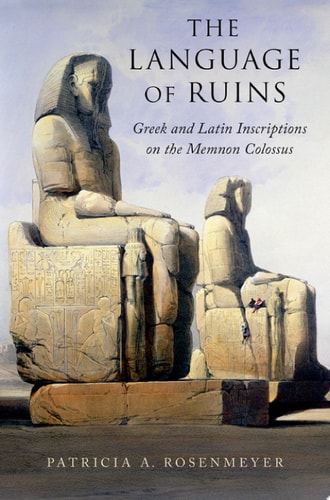
The Language of Ruins: Greek and Latin Inscriptions on the Memnon Colossus
0
0
As an Amazon Associate and affiliate partner, Menrva Books earns from qualifying purchases. Learn more
Author Description
A colossal statue, originally built to honor an ancient pharaoh, still stands today in Egyptian Thebes, with more than a hundred Greek and Latin inscriptions covering its lower surfaces. Partially damaged by an earthquake, and later re-identified as the Homeric hero Memnon, it was believed to "speak" regularly at daybreak. By the middle of the first century CE, tourists flocked to the colossus of Memnon to hear the miraculous sound, and left behind their marks of devotion (proskynemata): brief acknowledgments of having heard Memnon's cry; longer lists by Roman administrators; and more elaborate elegiac verses by both amateur and professional poets. The inscribed names left behind reveal the presence of emperors and soldiers, provincial governors and businessmen, elite women and military wives, and families with children. While recent studies of imperial literature acknowledge the colossus, few address the inscriptions themselves. This book is the first critical assessment of all the inscriptions considered in their social, cultural, and historical context. The Memnon colossus functioned as a powerful site of engagement with the Greek past, and appealed to a broad segment of society. The inscriptions shed light on contemporary attitudes toward sacred tourism, the role of Egypt in the Greco-Roman imagination, and the cultural legacy of Homeric epic. Memnon is a ghost from the Homeric past anchored in the Egyptian present, and visitors yearned for a "close encounter" that would connect them with that distant past. The inscriptions thus idealize Greece by echoing archaic literature in their verses at the same time as they reflect their own historical horizon. These and other subjects are expertly explored in the book, including a fascinating chapter on the colossus's post-classical life when the statue finds new worshippers among Romantic artists and poets in nineteenth-century Europe.
Menrva's Summary
THE THESIS
This book investigates the cultural and social significance of the Greek and Latin inscriptions found on the Colossus of Memnon in Egyptian Thebes. Patricia A. Rosenmeyer, a scholar of classical literature, utilizes these epigraphic records to analyze how ancient visitors engaged with the site as a nexus of Homeric legend and Roman-era tourism. The work argues that these inscriptions serve as a primary source for understanding the intersection of imperial identity, sacred travel, and the reception of the Greek past within the Roman world.
THE SCOPE MAP
What You Will Find
- A comprehensive analysis of over one hundred Greek and Latin inscriptions on the Memnon Colossus.
- Examination of the social demographics of ancient tourists, including soldiers, administrators, and elite women.
- Exploration of the statue's reception in nineteenth-century European Romanticism.
- Contextualization of the inscriptions within the broader framework of Greco-Roman literary and cultural history.
Scope Limits
- The text focuses primarily on the epigraphic evidence and its cultural implications rather than the architectural engineering of the statue itself.
- It does not provide an exhaustive archaeological report on the physical restoration of the monument.
THE AUTHORITY PERSPECTIVE
Scholars and classicists recognize this work as a foundational study for understanding the intersection of epigraphy and ancient tourism. Readers frequently note the academic rigor of the prose and the author's ability to synthesize diverse historical perspectives into a cohesive narrative.
Page Count:
296
Publication Date:
2018-01-01
Publisher:
Oxford University Press
ISBN-10:
0190875283
ISBN-13:
9780190875282
Religion
History
Tourism Studies
DESIGN General
English & College Success
Epigraphy
Ancient Egypt
Humanities
Ancient History
Cultural History
Professional Career & Trade
English
Archaeology
Community Tags
Other Editions(2)
Similar Books








Reader Comments
Share Your Thoughts
No comments yet. Be the first to share your thoughts!