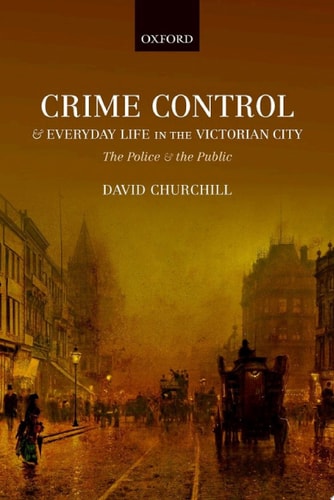
Crime Control and Everyday Life in the Victorian City: The Police and the Public
0
0
As an Amazon Associate and affiliate partner, Menrva Books earns from qualifying purchases. Learn more
Author Description
The history of modern crime control is usually presented as a narrative of how the state wrested control over the governance of crime from the civilian public. Most accounts trace the decline of a participatory, discretionary culture of crime control in the early modern era, and its replacement by a centralized, bureaucratic system of responding to offending. The formation of the 'new' professional police forces in the nineteenth century is central to this narrative: henceforth, it is claimed, the priorities of criminal justice were to be set by the state, as ordinary people lost what authority they had once exercised over dealing with offenders. This book challenges this established view, and presents a fundamental reinterpretation of changes to crime control in the age of the new police. It breaks new ground by providing a highly detailed, empirical analysis of everyday crime control in Victorian provincial cities - revealing the tremendous activity which ordinary people displayed in responding to crime - alongside a rich survey of police organization and policing in practice. With unique conceptual clarity, it seeks to reorient modern criminal justice history away from its established preoccupation with state systems of policing and punishment, and move towards a more nuanced analysis of the governance of crime. More widely, the book provides a unique and valuable vantage point from which to rethink the role of civil society and the state in modern governance, the nature of agency and authority in Victorian England, and the historical antecedents of pluralized modes of crime control which characterize contemporary society.
Menrva's Summary
THE THESIS
This book investigates whether the rise of professional police forces in the nineteenth century truly resulted in the state usurping all civilian authority over crime control. David S. Churchill, a historian specializing in the governance of crime, challenges the traditional narrative of state centralization by examining empirical evidence from Victorian provincial cities. He argues that ordinary citizens maintained a significant, active role in policing and justice, suggesting that the history of crime control is more pluralistic than previously understood.
THE SCOPE MAP
What You Will Find
- Empirical analysis of everyday crime control practices in Victorian provincial cities
- A comparative survey of police organization versus public participation
- A conceptual framework for understanding the governance of crime beyond state-centric models
Scope Limits
- The analysis is primarily focused on provincial urban centers rather than London or rural districts
- The study does not provide a comprehensive history of criminal law statutes or legislative reform
THE AUTHORITY PERSPECTIVE
Scholars in the field of criminal justice history recognize this work as a significant challenge to established narratives regarding the professionalization of policing. Readers frequently note the academic density of the prose and the depth of the archival research presented.
Page Count:
306
Publication Date:
2017-01-01
Publisher:
OUP Oxford
ISBN-10:
0192518739
ISBN-13:
9780192518736
History
British History
Law Enforcement
Special Topics
Criminology
Sociology
Community Tags
Similar Books