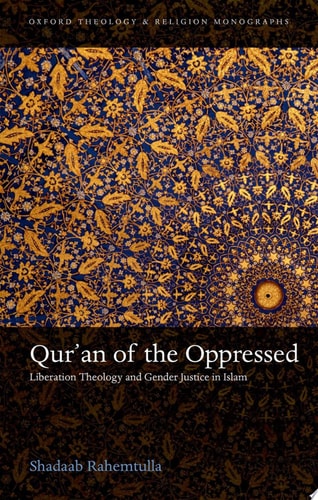
Qur'an of the Oppressed
0
0
As an Amazon Associate and affiliate partner, Menrva Books earns from qualifying purchases. Learn more
Author Description
This study analyses the commentaries of four Muslim intellectuals who have turned to scripture as a liberating text to confront an array of problems, from patriarchy, racism, and empire to poverty and interreligious communal violence. Shadaab Rahemtulla considers the exegeses of the South African Farid Esack (b. 1956), the Indian Asghar Ali Engineer (1939-2013), the African American Amina Wadud (b. 1952), and the Pakistani American Asma Barlas (b. 1950). Rahemtulla examines how these intellectuals have been able to expound this seventh-century Arabian text in a socially liberating way, addressing their own lived realities of oppression, and thus contexts that are worlds removed from that of the text's immediate audience. Through a close reading of their works, he underlines the importance of both the ethico-social content of the Qur'an and their usage of new and innovative reading practices. This work provides a rich analysis of the thought-ways of specific Muslim intellectuals, thereby substantiating a broadly framed school of thought. Rahemtulla draws out their specific and general importance without displaying an uncritical sympathy. He sheds light on the impact of modern exegetical commentary which is more self-consciously concerned with historical context and present realities. In a mutually reinforcing way, this work thus illuminates both the role of agency and hermeneutical approaches in modern Islamic thought.
Menrva's Summary
THE THESIS
This study investigates how modern Muslim intellectuals interpret the Qur'an as a liberating text to address contemporary systemic injustices such as patriarchy, racism, and poverty. Shadaab Rahemtulla, a scholar of Islamic thought, analyzes the exegetical frameworks of four prominent thinkers: Farid Esack, Asghar Ali Engineer, Amina Wadud, and Asma Barlas. By examining their methodologies, the author demonstrates how these intellectuals reconcile seventh-century scripture with the lived realities of modern oppression through innovative hermeneutical practices.
THE SCOPE MAP
What You Will Find
- Comparative analysis of four specific Muslim intellectuals and their unique exegetical approaches.
- Examination of the intersection between Islamic scripture and modern social issues including empire, communal violence, and gender inequality.
- Discussion of the shift toward context-conscious, historical-critical reading practices in modern Islamic thought.
Scope Limits
- The study focuses exclusively on the selected four intellectuals and does not provide an exhaustive survey of all contemporary Islamic liberation theology.
- The work does not offer a theological defense of the Qur'an itself but rather analyzes the human agency involved in its modern interpretation.
THE AUTHORITY PERSPECTIVE
Scholars and students of Islamic studies frequently cite this work as a significant contribution to understanding the evolution of modern hermeneutics. Experts note the academic rigor of the text, highlighting its balanced approach in evaluating the intellectual contributions of these figures without resorting to uncritical praise.
Page Count:
248
Publication Date:
2017-01-01
Publisher:
Oxford University Press
ISBN-10:
0192516493
ISBN-13:
9780192516497
Religion
Hermeneutics
Sociology
Theology
Islamic Studies
Community Tags
Similar Books