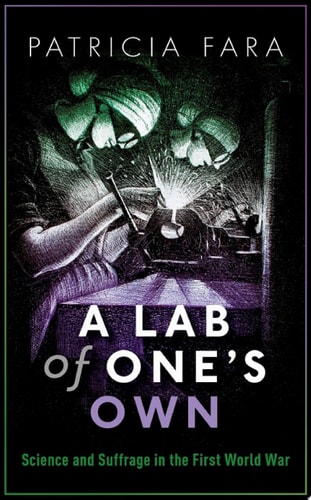
A Lab of One's Own: Science and Suffrage in the First World War
0
0
As an Amazon Associate and affiliate partner, Menrva Books earns from qualifying purchases. Learn more
Author Description
2018 marked a double centenary: peace was declared in war-wracked Europe, and women won the vote after decades of struggle. A Lab of One's Own commemorates both anniversaries by revealing the untold lives of female scientists, doctors, and engineers who undertook endeavours normally reserved for men. It tells fascinating and extraordinary stories featuring initiative, determination, and isolation, set against a backdrop of war, prejudice, and disease. Patricia Fara investigates the enterprising careers of these pioneering women and their impact on science, medicine, and the First World War. Suffrage campaigners aligned themselves with scientific and technological progress. Defying protests about their intellectual inferiority and child-bearing responsibilities, during the War they won support by mobilizing women to enter conventionally male domains. A Lab of One's Own focuses on the female experts who carried out vital research. They had already shown exceptional resilience by challenging accepted norms to pursue their careers, now they played their part in winning the War at home and overseas. In 1919, the suffragist Millicent Fawcett declared triumphantly that 'The war revolutionised the industrial position of women. It found them serfs, and left them free.' She was wrong: Women had helped the country to victory, had won the vote for those over thirty - but had lost the battle for equality. A Lab of One's Own is essential reading to understand and eliminate the inequalities still affecting professional women today.
Menrva's Summary
THE THESIS
This book investigates how the First World War served as a catalyst for women to enter scientific and medical professions, while simultaneously examining the persistent systemic inequalities that remained after the conflict concluded. Patricia Fara, a historian of science, utilizes archival research and biographical accounts to document the contributions of female scientists, doctors, and engineers. She argues that while the war provided a temporary opening for women to demonstrate their professional capabilities, the broader societal structures of prejudice and intellectual gatekeeping largely remained intact.
THE SCOPE MAP
What You Will Find
- Biographical profiles of female scientists, doctors, and engineers active during the 1914-1918 period.
- Analysis of the intersection between the suffrage movement and scientific progress.
- Examination of the institutional barriers faced by women in academia and medicine.
Scope Limits
- The text focuses primarily on the British context and does not provide a comprehensive global history of women in science during this era.
THE AUTHORITY PERSPECTIVE
Historians and reviewers frequently note the book's success in highlighting overlooked figures within the history of science. Experts appreciate the author's ability to connect wartime labor shifts with the long-term struggle for professional equality.
Page Count:
350
Publication Date:
2017-01-01
Publisher:
OUP Oxford
ISBN-10:
0192514172
ISBN-13:
9780192514172
Biography
History
Science
World War
Great Britain
Social History
Womens Studies
Earth Sciences
Suffragists
Community Tags
Similar Books