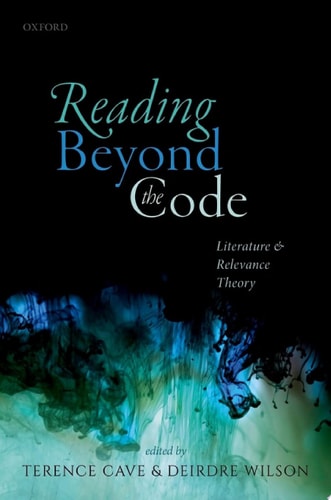
Reading Beyond the Code: Literature and Relevance Theory
0
0
As an Amazon Associate and affiliate partner, Menrva Books earns from qualifying purchases. Learn more
Author Description
This book explores the value for literary studies of the model of communication known as relevance theory. Drawing on a wide range of examples—lyric poems by Yeats, Herrick, Heaney, Dickinson, and Mary Oliver, novels by Cervantes, Flaubert, Mark Twain, and Edith Wharton—nine of the ten essays are written by literary specialists and use relevance theory both as a broad framing perspective and as a resource for detailed analysis. The final essay, by Deirdre Wilson, co-founder (with Dan Sperber) of relevance theory, takes a retrospective view of the issues addressed by the volume and considers the implications of literary studies for cognitive approaches to communication. Relevance theory, described by Alastair Fowler as 'nothing less than the makings of a radically new theory of communication, the first since Aristotle's', offers a comprehensive pragmatics of language and communication grounded in evidence about the ways humans think and behave. While designed to capture the everyday murmur of conversation, gossip, peace-making, hate speech, love speech, 'body-language', and the chatter of the internet, it covers the whole spectrum of human modes of communication, including literature in the broadest sense as a characteristically human activity. Reading Beyond the Code is unique in using relevance theory as a prime resource for literary study, and it is also the first to claim that the model works best for literature when understood in the light of a broader cognitive approach, focusing on a range of phenomena that support an 'embodied' conception of cognition and language. This broadened perspective serves to enhance the value for literary studies of the central claim of relevance theory, that the 'code model' is fundamentally inadequate to account for human communication, and in particular for the modes of communication that are proper to literature.
Menrva's Summary
THE THESIS
This volume investigates the utility of relevance theory as a framework for interpreting literary texts and understanding the cognitive processes involved in literary communication. The authors, including co-founder of relevance theory Deirdre Wilson and various literary specialists, argue that the traditional 'code model' of communication fails to account for the nuances of literary expression. By applying a cognitive approach to literature, the contributors demonstrate how relevance theory provides a more robust mechanism for analyzing how readers derive meaning from complex, non-literal, and artistic language.
THE SCOPE MAP
What You Will Find
- An application of relevance theory to diverse literary forms including lyric poetry and novels.
- Analysis of works by authors such as Yeats, Cervantes, Flaubert, and Mark Twain.
- A retrospective examination of the intersection between cognitive science and literary studies.
- A critique of the 'code model' in favor of a pragmatics-based approach to communication.
Scope Limits
- The text focuses primarily on the intersection of cognitive linguistics and literary analysis rather than providing a general introduction to literary theory.
- It does not attempt to provide a comprehensive history of pragmatics, focusing instead on the specific application of relevance theory.
THE AUTHORITY PERSPECTIVE
Experts recognize this work as a significant bridge between cognitive science and the humanities, noting its utility for scholars interested in the mechanics of interpretation. Readers frequently highlight the academic density of the prose, which assumes a foundational understanding of both linguistic theory and literary analysis.
Page Count:
256
Publication Date:
2018-01-01
Publisher:
OUP Oxford
ISBN-10:
0192513788
ISBN-13:
9780192513786
English
Pragmatics
Communication Theory
English & College Success
Literary theory
Cognitive Linguistics
Literary Criticism
Community Tags
Similar Books