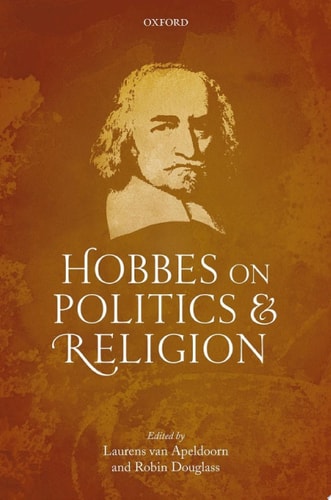
Hobbes on Politics and Religion
0
0
As an Amazon Associate and affiliate partner, Menrva Books earns from qualifying purchases. Learn more
Author Description
Thomas Hobbes, one of the most important figures in the history of political philosophy, is still widely regarded as a predominantly secular thinker. Yet a great deal of his political thought was motivated by the need to address problems of a distinctively religious nature. This is the first collection of essays dedicated to the complex and rich intersections between Hobbes's political and religious thought. Written by experts in the field, the volume opens up new directions for thinking about his treatment of religion as a political phenomenon and the political dimensions of his engagement with Christian doctrines and their history. The chapters investigate his strategies for showing how his provocative political positions could be accepted by different religious audiences for whom fidelity to religious texts was of crucial importance, while also considering the legacy of his ideas and examining their relevance for contemporary concerns. Some chapters do so by pursuing mainly historical inquiries about the motives and circumstances of Hobbes's writings, while others reconstruct the logic of his arguments and test their philosophical coherence. They thus offer wide-ranging and sometimes conflicting assessments of Hobbes's ideas, yet they all demonstrate how closely intertwined his political and religious preoccupations are and thereby showcase how this perspective can help us to better understand his thought.
Menrva's Summary
THE THESIS
This collection of essays investigates the core question of how Thomas Hobbes’s political philosophy is fundamentally shaped by and inextricably linked to his engagement with religious doctrine. The editors, Laurens van Apeldoorn and Robin Douglass, curate a series of scholarly contributions that challenge the traditional view of Hobbes as a purely secular thinker. By analyzing his strategies for reconciling political authority with religious fidelity, the volume provides a framework for understanding the religious dimensions of his political arguments.
THE SCOPE MAP
What You Will Find
- Historical inquiries into the motives and circumstances surrounding Hobbes’s primary texts
- Philosophical reconstructions of the logic and coherence of Hobbesian arguments
- Analysis of Hobbes’s treatment of religion as a political phenomenon
- Examination of the legacy of Hobbes’s ideas regarding Christian doctrine
Scope Limits
- The volume does not provide a comprehensive biography of Hobbes
- The text does not offer a singular, unified interpretation of Hobbes’s religious views, but rather presents a variety of scholarly perspectives
THE AUTHORITY PERSPECTIVE
Experts highlight this collection as a significant contribution to Hobbesian scholarship, noting its success in bridging the gap between political theory and religious history. Readers frequently observe that the prose maintains a high level of academic rigor, making it most suitable for students and scholars of political philosophy.
Page Count:
311
Publication Date:
2018-01-01
Publisher:
OUP Oxford
ISBN-10:
0192525107
ISBN-13:
9780192525109
Philosophy
Religion
Political Theory
Philosophy history
History & Surveys
Community Tags
Other Editions(3)
Similar Books