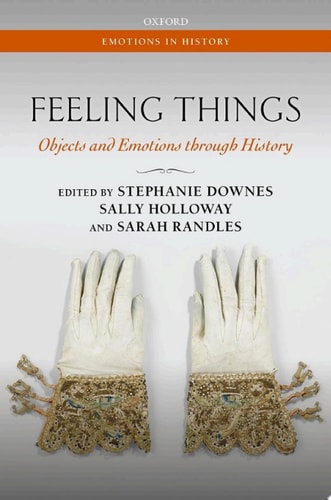
Feeling Things: Objects and Emotions through History
0
0
As an Amazon Associate and affiliate partner, Menrva Books earns from qualifying purchases. Learn more
Author Description
This interdisciplinary essay collection investigates the various interactions of people, feelings, and things throughout premodern Europe. It focuses on the period before mass production, when limited literacy often prioritised material methods of communication. The subject of materiality has been of increasing significance in recent historical inquiry, alongside growing emphasis on the relationships between objects, emotions, and affect in archaeological and sociological research. The historical intersections between materiality and emotions, however, have remained under-theorised, particularly with respect to artefacts that have continuing resonance over extended periods of time or across cultural and geographical space. Feeling Things addresses the need to develop an appropriate cross-disciplinary theoretical framework for the analysis of objects and emotions in European history, with special attention to the need to track the shifting emotional valencies of objects from the past to the present, and from one place and cultural context to another. The collection draws together an international group of historians, art historians, curators, and literary scholars working on a variety of cultural, literary, visual, and material sources. Objects considered include books, letters, prosthetics, religious relics, shoes, stone, and textiles. Many of these have been preserved in international galleries, museums, and archives, while others have remained in their original locations, even as their contexts have changed over time. The chapters consider the ways in which emotions such as despair, fear, grief, hope, love, and wonder become inscribed in and ascribed to these items, producing 'emotional objects' of significance and agency. Such objects can be harnessed to create, affirm, or express individual relationships, as, for example, in religious devotion and practice, or in the construction of cultural, communal, and national identities.
Menrva's Summary
THE THESIS
This collection investigates how material objects in premodern Europe functioned as vessels for human emotion and agents of social interaction. The editors, Sally Holloway, Sarah Randles, and Stephanie Downes, curate an interdisciplinary set of essays that bridge the gap between historical inquiry and material culture studies. By examining artifacts ranging from religious relics to everyday textiles, the contributors argue that objects possess shifting emotional valencies that evolve across time and cultural contexts.
THE SCOPE MAP
What You Will Find
- Analysis of premodern European material culture prior to mass production.
- Theoretical frameworks for interpreting the intersection of affect and physical artifacts.
- Case studies on diverse objects including books, letters, prosthetics, shoes, and stone.
- Exploration of how objects construct individual, communal, and national identities.
Scope Limits
- The collection focuses primarily on premodern Europe and does not provide a global history of material culture.
- It does not offer a comprehensive catalog of all emotional objects but rather selects specific examples to demonstrate methodological approaches.
THE AUTHORITY PERSPECTIVE
Scholars in the field of material culture and the history of emotions recognize this work as a significant contribution to an under-theorized area of historical inquiry. Readers frequently note the academic rigor of the essays, which successfully synthesize perspectives from art history, archaeology, and literary studies.
Page Count:
304
Publication Date:
2018-01-01
Publisher:
OUP Oxford
ISBN-10:
019252366X
ISBN-13:
9780192523662
History
European History
Europe
Special Topics
Cultural History
History of the Americas
Art History
History of Emotions
Community Tags
Similar Books


Reader Comments
Share Your Thoughts
No comments yet. Be the first to share your thoughts!