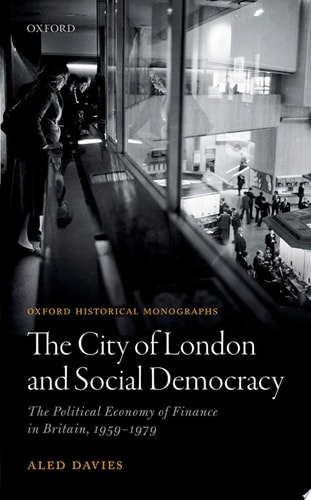
The City of London and Social Democracy
0
0
As an Amazon Associate and affiliate partner, Menrva Books earns from qualifying purchases. Learn more
Author Description
The City Of London And Social Democracy Examines The Relationship Between The Financial Sector And The State In Post-war Britain. The Key Argument Made In Aled Davies's Study Is That Changes To The Financial Sector During The 1960s And 1970s Undermined The State's Capacity To Sustain And Develop A Modern Industrial Economy. Social Democratic Economic Strategy Was Constrained By The Institutionalization Of Investment In Pension And Insurance Funds; The Fragmentation Of The Nation's Oligopolistic Domestic Banking System; The Emergence Of An Unregulated International Capital Market Based In London; And The Breakdown Of The Bretton Woods International Monetary System. Novel Attempts To Reconfigure Social Democratic Economic Strategy In Response To These Changes Ultimately Proved Unsuccessful. Meanwhile, The Assumption That National Prosperity Could Only Be Achieved Through Industrial Growth Was Challenged By A Reconceptualization Of Britain As A Fundamentally Financial And Commercial Nation — An Idea That Was Successfully Promoted By The City Itself. These Findings Assert The Need To Place The Thatcher Governments' Subsequent Neoliberal Economic Revolution, Which Saw The Acceleration Of Deindustrialization And The Triumph Of The City Of London As A Pre-eminent International Financial Centre, Within A Broader Material, Institutional, And Cultural Context Previously Underappreciated By Historians.
Menrva's Summary
THE THESIS
This study investigates how the evolving relationship between the City of London's financial sector and the British state during the 1960s and 1970s eroded the foundations of post-war social democratic economic policy. Aled Davies, a historian specializing in political economy, utilizes archival research and institutional analysis to argue that the structural transformation of financial markets constrained the state's ability to manage industrial growth. The author demonstrates how the rise of international capital markets and the fragmentation of domestic banking systems shifted the national identity from an industrial power to a financial hub, setting the stage for the subsequent neoliberal transition.
THE SCOPE MAP
What You Will Find
- Analysis of the institutionalization of investment through pension and insurance funds
- Examination of the breakdown of the Bretton Woods international monetary system
- Historical assessment of the shift from industrial-focused policy to financial-commercial dominance
- Contextualization of the Thatcher-era economic reforms within long-term structural changes
Scope Limits
- The study focuses primarily on the British state and the City of London rather than global financial history
- The analysis concludes at the transition to the neoliberal era rather than covering contemporary financial developments
THE AUTHORITY PERSPECTIVE
Historians and political economists recognize this work as a rigorous examination of the structural constraints placed on post-war British governance. Scholars frequently cite the text for its detailed institutional analysis of how financial sector shifts influenced national economic policy.
Page Count:
272
Publication Date:
2017-01-01
Publisher:
Oxford University Press
ISBN-10:
0192526103
ISBN-13:
9780192526106
Economics
History
British History
Finance
Community Tags
Similar Books