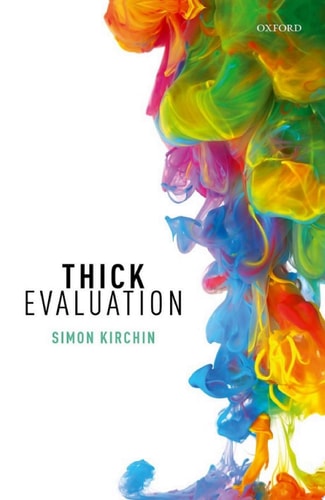
Thick Evaluation
0
0
As an Amazon Associate and affiliate partner, Menrva Books earns from qualifying purchases. Learn more
Author Description
This is an open access title available under the terms of a CC BY-NC-ND 4.0 International licence. It is free to read at Oxford Scholarship Online and offered as a free PDF download from OUP and selected open access locations. We use evaluative terms and concepts every day. We call actions right and wrong, teachers wise and ignorant, and pictures elegant and grotesque. Philosophers place evaluative concepts into two camps. Thin concepts, such as goodness and badness, and rightness and wrongness have evaluative content, but they supposedly have no or hardly any nonevaluative, descriptive content: they supposedly give little or no specific idea about the character of the person or thing described. In contrast, thick concepts such as kindness, elegance and wisdom supposedly give a more specific idea of people or things. Yet, given typical linguistic conventions, thick concepts also convey evaluation. Kind people are often viewed positively whilst ignorance has negative connotations. The distinction between thin and thick concepts is frequently drawn in philosophy and is central to everyday life. However, very few articles or books discuss the distinction. In this full-length study, Simon Kirchin discusses thin and thick concepts, highlighting key assumptions, questions and arguments, many of which have gone unnoticed. Kirchin focuses in on the debate between 'separationists' (those who think that thick concepts can be separated into component parts of evaluative, often very 'thin', content and nonevaluative content) and 'nonseparationists' (who deny this). Thick Evaluation argues for a version of nonseparationism, and in doing so argues both that many concepts are evaluative and also that evaluation is not exhausted by thin positive and negative stances.
Menrva's Summary
THE THESIS
This book investigates the philosophical distinction between thin and thick evaluative concepts and argues for a nonseparationist perspective. Simon Kirchin, a scholar in moral philosophy, examines the linguistic and conceptual frameworks that categorize terms like 'good' (thin) versus 'kind' or 'elegant' (thick). By analyzing the debate between separationists and nonseparationists, Kirchin challenges the assumption that evaluative content can be neatly partitioned from descriptive content.
THE SCOPE MAP
What You Will Find
- A comprehensive analysis of the thin-thick concept distinction in moral philosophy.
- A detailed examination of the separationist versus nonseparationist debate.
- Arguments regarding the nature of evaluative content in language.
Scope Limits
- The text does not provide a general introduction to ethics for laypeople.
- It does not cover the historical evolution of every evaluative term in the English language.
THE AUTHORITY PERSPECTIVE
Experts recognize this work as a significant contribution to metaethical literature, specifically regarding the mechanics of evaluative language. Readers frequently note the academic density of the prose, which is intended for students and scholars of philosophy.
Page Count:
210
Publication Date:
2017-01-01
Publisher:
OUP Oxford
ISBN-10:
0192525174
ISBN-13:
9780192525178
Philosophy
Academic
Ethics
Evaluation
Linguistics
Metaethics
Community Tags
Similar Books