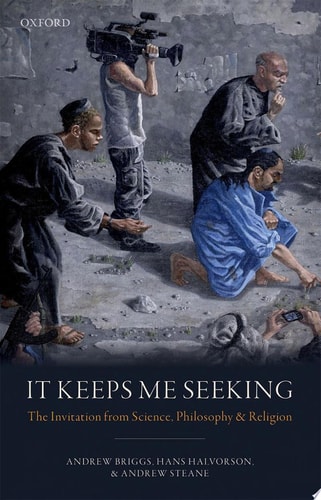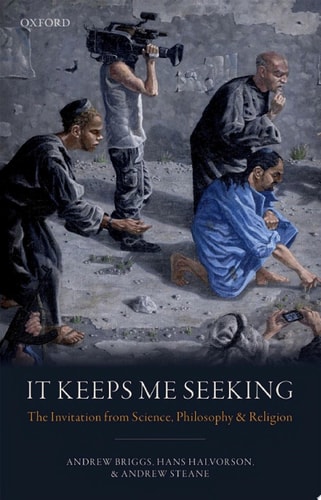
It Keeps Me Seeking: The Invitation from Science, Philosophy and Religion
Author Description
Here is a fresh look at how science contributes to the bigger picture of human flourishing, through a collage of science and philosophy, richly illustrated by the authors' own experience and personal reflection. They survey the territory of fundamental physics, machine learning, philosophy of human identity, evolutionary biology, miracles, arguments from design, naturalism, the history of ideas, and more. The natural world can be appreciated not only for itself, but also as an eloquent gesture, a narrative and a pointer beyond itself. Our human journey is not to a theorem or a treatise, but to a meeting which encompasses all our capacities. In this meeting, science is the means to find out about the structure of the physical world of which we are a part, not a means to reduce ourselves and our fellow human beings to mere objects of scrutiny, and still less a means to attempt the utterly futile exercise of trying to do that to God. We have intellectual permission to be open to the notion that God can be trusted and known. The material world encourages an open-hearted reaching out to something more, with a freedom to seek and to be received by what lies beyond the scope of purely impersonal descriptions and attitudes.
Menrva's Summary
THE THESIS
This book investigates whether the natural world, when viewed through the lenses of science, philosophy, and religion, functions as a pointer toward a transcendent reality rather than a closed material system. The authors, a team of distinguished academics including a professor of physics and a philosopher of science, synthesize their professional expertise with personal reflection to argue that scientific inquiry does not necessitate a reductionist worldview. They propose that the structure of the physical universe invites human beings to engage in a broader search for meaning that encompasses both empirical observation and theological openness.
THE SCOPE MAP
What You Will Find
- Analysis of fundamental physics and evolutionary biology as frameworks for understanding existence.
- Philosophical inquiries into human identity and the limitations of naturalism.
- Discussions on the history of ideas, machine learning, and the concept of miracles.
- Arguments regarding the design of the universe and the potential for a personal relationship with the divine.
Scope Limits
- The text does not provide a definitive scientific proof for the existence of God.
- It avoids exhaustive technical deep-dives into specific machine learning algorithms or advanced quantum mechanics equations.
THE AUTHORITY PERSPECTIVE
Readers frequently note the accessible yet intellectually rigorous nature of the prose, which bridges the gap between specialized scientific discourse and philosophical inquiry. Experts highlight this as a valuable contribution for those seeking to reconcile empirical scientific findings with a personal, open-hearted approach to faith and existence.
Page Count:
366
Publication Date:
2018-01-01
Publisher:
OUP Oxford
ISBN-10:
0192535870
ISBN-13:
9780192535870
Non-Fiction
Evolutionary Biology
Theology
Philosophy of
Earth Sciences
Physics
Science and Religion
Science
Community Tags
Similar Books