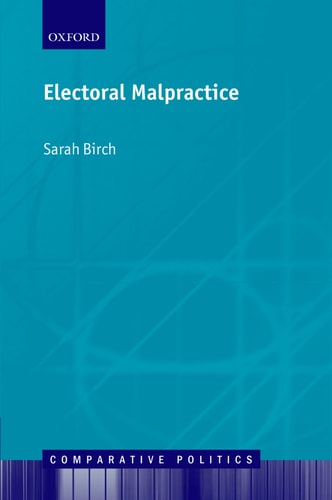
Electoral Malpractice
0
0
As an Amazon Associate and affiliate partner, Menrva Books earns from qualifying purchases. Learn more
Author Description
Elections ought in theory to go a long way toward making democracy 'work', but in many contexts, they fail to embody democratic ideals because they are affected by electoral manipulation and misconduct. This book undertakes an analytic and explanatory investigation of electoral malpractice, which is understood as taking three principal forms: manipulation of the rules governing elections, manipulation of vote preference formation and expression, and manipulation of the voting process.Electoral Malpractice--which is comparative in nature--starts out by providing a conceptual definition and typology of electoral malpractice, before considering evidence for the causes of this phenomenon. The principal argument of the book is that factors affecting the costs of electoral malpractice are crucial in determining whether leaders will, in any given context, seek to rig elections. Among the most important factors of this sort are the linkages between elites and citizens, and in particular the balance between relations of the civil-society and clientelist types. These linkages play an important role in determining how much legitimacy leaders will lose by engaging in electoral manipulation as well as the likely consequences of legitimacy loss.The study also shows how electoral malpractice might be reduced by means of a variety of strategies designed to raise the cost of electoral manipulation by increasing the ability of civil society and international actors to monitor and denounce it.Comparative Politics is a series for students, teachers, and researchers of political science that deals with contemporary government and politics. Global in scope, books in the series are characterised by a stress on comparative analysis and strong methodological rigour. The series is published in association with the European Consortium for Political Research. For more information visit: www.essex.ac.uk/ecpr. The Comparative Politics Series is edited by Professor David M. Farrell, School of Politics and International Relations, University College Dublin, Kenneth Carty, Professor of Political Science, University of British Columbia, and Professor Dirk Berg-Schlosser, Institute of Political Science, Philipps University, Marburg.
Menrva's Summary
THE THESIS
This book investigates the mechanisms and causes of electoral malpractice, questioning why democratic processes frequently fail to reflect democratic ideals due to systemic manipulation. Sarah Birch, a scholar in political science, utilizes a comparative framework to categorize electoral misconduct into three distinct forms: rule manipulation, preference interference, and voting process distortion. The author argues that the decision to engage in malpractice is primarily a cost-benefit calculation for political leaders, heavily influenced by the nature of elite-citizen linkages and the strength of civil society.
THE SCOPE MAP
What You Will Find
- A comprehensive typology defining the three primary forms of electoral malpractice.
- Analysis of the cost-benefit factors that influence political leaders' decisions to rig elections.
- Examination of the role of civil society and clientelist networks in determining the legitimacy costs of manipulation.
- Strategic recommendations for international actors and civil society to increase the costs of electoral misconduct through monitoring and denunciation.
THE AUTHORITY PERSPECTIVE
Experts in political science recognize this work as a foundational text for understanding the comparative mechanics of electoral integrity. Readers frequently note the analytical rigor and the clarity with which the author applies theoretical frameworks to diverse global political contexts.
Page Count:
224
Publication Date:
2012-03-02
Publisher:
Oxford University Press
ISBN-10:
0199606161
ISBN-13:
9780199606160
Comparative Politics
Democracy
Government
Elections
Community Tags
Other Editions(2)

Similar Books

Reader Comments
Share Your Thoughts
No comments yet. Be the first to share your thoughts!